 Free & discreet shipping on all prescriptions
 No insurance required


February 24, 2026
Ayurveda Therapies: Types, Benefits & Ayurvedic Treatments
Ayurveda, the ancient system of natural healing, has been practiced for thousands of years in India. Its holistic approach to health focuses on balancing the mind, body, and spirit through natural remedies, diet, lifestyle adjustments, and therapies. In this post, we’ll explore the core principles of Ayurveda and how you can incorporate them into your daily routine for a healthier and more balanced life.
Ayurveda therapies are the practical application of Ayurvedic medicine. Unlike treatments that only suppress symptoms, Ayurvedic therapies work by correcting internal imbalances, removing toxins, improving digestion, and restoring harmony between the body and mind.
At Yuvrit, Ayurveda therapies are delivered as medical treatments, not wellness rituals. Each therapy is prescribed after a detailed Ayurvedic consultation and is selected based on the patient’s condition, dosha imbalance, digestive strength, and stage of disease. These therapies are used to manage joint pain, digestive disorders, stress-related conditions, lifestyle diseases, hormonal imbalances, and chronic health issues.
This guide explains the different types of Ayurveda therapies offered at Yuvrit, how they work, and how they are used across common health conditions.
What Are Ayurveda Therapies?
Ayurveda therapies are structured treatment procedures that use medicated oils, herbal formulations, heat, pressure, and detoxification techniques to heal the body from within.
According to Ayurveda, disease develops due to:
-
Imbalance of Vata, Pitta, or Kapha dosha
-
Weak digestive fire (Agni)
-
Accumulation of toxins (Ama)
-
Improper diet and lifestyle
Ayurvedic therapies aim to reverse these processes by cleansing the body, strengthening digestion, nourishing tissues, and stabilising the nervous system.
Types of Ayurveda Therapies
Ayurveda therapies can be broadly grouped based on their purpose and method of action. Each group below includes therapies available at Yuvrit and can be interlinked directly
Panchakarma - the complete Ayurvedic detox
Panchakarma is the most comprehensive Ayurvedic detox therapy, designed to eliminate deepseated toxins from the body and restore internal balance. It is not a single treatment but a structured program comprising preparation (Poorvakarma), detoxification (Pradhanakarma), and rejuvenation (Paschatkarma).
Panchakarma consists of five core procedures, Vamana, Virechana, Basti, Nasya, and Raktamokshana, applied selectively based on the patient's condition and dosha imbalance. No two Panchakarma programs at Yuvrit are identical.
Panchakarma is recommended for: chronic digestive disorders, diabetes and metabolic dysfunction, skin conditions, hormonal imbalances, PCOS, recurrent joint pain, and as preventive annual detox.
Related reading: Panchakarma for weight loss | Panchakarma for knee pain | Panchakarma for PCOS | Panchakarma for high blood pressure
Abhyanga - full-body warm oil massage
Abhyanga is a full-body oil massage performed using warm, medicated oils selected according to the patient's dosha imbalance and primary condition. The strokes follow specific directions aligned with the circulatory and lymphatic systems to enhance absorption of medicinal oils into deeper tissues.
Abhyanga improves peripheral circulation, nourishes all seven body tissues (Dhatus), calms the nervous system, and reduces systemic Vata. It is used as a standalone therapy and as the foundational daily therapy within a Panchakarma program.
Abhyanga is beneficial for: joint and muscle stiffness, stress and fatigue, poor sleep, nervous system imbalance, and as preparatory therapy before deeper detox procedures.
Related reading: Abhyanga massage for weight loss | Abhyanga massage for back pain
Shirodhara - continuous oil flow for the nervous system
Shirodhara is a deeply calming therapy in which a continuous, uninterrupted stream of warm medicated oil is poured gently over the forehead (the Ajna marma point) for 30–45 minutes. This stimulates the hypothalamus, calms the HPA axis, and directly regulates the nervous system's stress response.
The oil used varies by condition, Ksheerabala Tailam for neurological disorders, Brahmi Tailam for stress and anxiety, and Takra (medicated buttermilk) for Pitta-related conditions.
Shirodhara is recommended for: chronic stress and anxiety, insomnia, mental fatigue, migraines, and stress-related hair fall.
Related reading: Shirodhara for migraine | Shirodhara for anxiety | Shirodhara for sleep disorders | Shirodhara for hair fall
Virechana - therapeutic purgation
Virechana is a controlled, medicated purgation therapy that eliminates excess Pitta from the gastrointestinal tract, liver, and blood. It is administered after several days of internal oleation (Snehapana) using medicated ghee, which loosens toxins from tissues and mobilises them into the gut for elimination.
Virechana is one of the most important Panchakarma procedures with significant documented effects on metabolic reset, hormonal regulation, and skin purification.
Virechana is used for: acidity and GERD, inflammatory skin conditions, PCOS, hormonal imbalance, weight management, liver disorders, and as fertility preparation.
Related reading: Virechana for weight loss | Virechana for fertility | Virechana for skin conditions
Kati Basti - warm oil retention for the lower back
Kati Basti is a localised oil retention therapy in which a well of black gram dough is constructed over the lumbar spine and filled with warm, medicated oil maintained at a consistent temperature. The oil deeply penetrates the intervertebral discs, spinal ligaments, and surrounding musculature, providing both lubrication and anti-inflammatory relief.
A typical Kati Basti session lasts 30–45 minutes and is followed by a gentle Abhyanga massage of the back and legs. Most treatment courses consist of 7–14 consecutive daily sessions.
Kati Basti is recommended for: lower back pain, lumbar spondylosis, slip disc, sciatica, and post-surgical back stiffness.
Related reading: Kati Basti for lower back pain | Kati Basti for slip disc | Kati Basti for osteoarthritis
Janu Basti - targeted oil therapy for the knees
Janu Basti follows the same principle as Kati Basti but is focused on the knee joint. Warm medicated oil is retained within a dough enclosure over the knee for 30–40 minutes, reducing inflammation in the synovial membrane, improving joint lubrication, and slowing cartilage degeneration.
Janu Basti is used for: knee osteoarthritis, degenerative joint disease, post-surgical knee stiffness, and sports-related knee injuries.
Related reading: Ayurvedic knee treatment
Greeva Basti - neck and cervical spine therapy
Greeva Basti targets the cervical vertebrae and surrounding musculature using the same oil retention technique. It is highly effective for conditions where nerve compression, disc degeneration, or chronic muscular tension in the neck region is present.
Greeva Basti is used for: cervical spondylosis, chronic neck pain, shoulder stiffness, and cervicogenic headaches.
Related reading: Ayurvedic treatment for cervical spondylosis
Nasya - nasal administration therapy
Nasya involves administering medicated oils, herbal juices, or powders through the nasal passage. The nasal route provides direct access to the central nervous system and the structures of the head, neck, and upper respiratory tract. According to Ayurveda, the nose is considered the gateway to the brain (Shirasah Dwaaram).
The formulation used varies by condition, Anu Tailam for sinusitis and allergies, Brahmi Ghee for neurological conditions, and Ksheerabala Tailam for migraine and cervical issues.
Nasya is used for: sinusitis and allergic rhinitis, chronic headaches and migraines, cervical spondylosis, hormonal and neurological balance, and stress-related hair fall.
Related reading: Nasya for sinusitis | Nasya for migraine
Vamana - Kapha cleansing emesis therapy
Vamana is a controlled, medically supervised therapeutic emesis procedure that eliminates excess Kapha from the respiratory and gastrointestinal tracts. It is one of the five core Panchakarma procedures and is administered only after thorough preparation using oleation and fomentation therapies over several days.
Vamana is indicated for: bronchial asthma, chronic skin conditions including psoriasis and eczema, obesity driven by Kapha accumulation, and recurring respiratory congestion.
Related reading: Vamana treatment for psoriasis
Vasti - medicated enema therapy
Vasti is considered the most important of all Panchakarma procedures because Vata is the primary force behind all movement and biological processes in the body. Administering medicated formulations through the rectal route directly pacifies Vata and cleanses the colon, the principal site of Vata accumulation.
Two types of Basti are used: Anuvasana Vasti (oil-based, nourishing) and Kashaya Vasti (decoction-based, cleansing). They are often administered in alternating cycles known as Yoga Vasti.
Basti is used for: Vata-related joint disorders, constipation and IBS, neurological conditions, reproductive health disorders, and as a core component of most Panchakarma programs.
Udwartanam - dry herbal powder massage
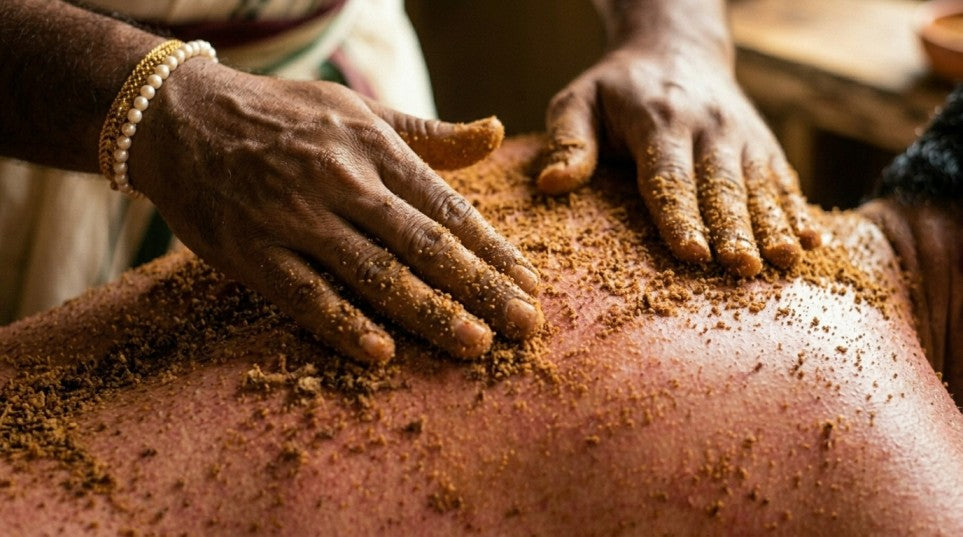
Udwartanam is a dry powder massage therapy performed using coarse herbal powders applied in upward strokes against the direction of hair growth. This creates friction heat, breaks down subcutaneous fat deposits, and stimulates the lymphatic system and metabolism. Unlike Abhyanga, which uses oil, Udwartanam is dry and stimulating — making it specifically indicated for Kapha excess.
Udwartanam is included in: weight management programs, metabolic disorder treatments, and lymphatic drainage support.
Related reading: Udwartanam for weight loss
Potli Massage (Kizhi) - medicated bundle therapy
Potli massage, known in classical Ayurveda as Kizhi, uses bundles of medicated herbs, rice, or sand heated in warm oil and applied rhythmically to the body. Different types are used depending on the condition: Elakizhi (leaf bundle) for musculoskeletal pain, Njavara Kizhi (medicated rice bundle) for muscle wasting and rehabilitation, and Podi Kizhi (powder bundle) for Kapha disorders.
Potli massage is beneficial for: muscle wasting, post-injury rehabilitation, arthritis with muscle weakness, neuromuscular disorders, and joint stiffness unresponsive to oil-based therapies alone.
Ayurvedic Gut Reset Therapy
Ayurvedic Gut Reset Therapy is a structured protocol that combines internal herbal medicines, dietary corrections, and selected detox therapies. primarily Virechana to restore digestive strength, correct gut dysbiosis, and reduce systemic toxin accumulation.
Since digestion is considered the foundation of health in Ayurveda, this therapy plays a central role in managing many chronic conditions that originate from impaired Agni (digestive fire). It is used for: acidity and GERD, IBS and bloating, chronic constipation, and recurrent indigestion.
Ayurvedic Stress Relief Therapy
This therapy combines Shirodhara, Abhyanga, Nasya, and supportive herbal formulations to stabilise the nervous system and reduce stress-related physical and psychological symptoms. It is designed for sustained nervous system regulation rather than temporary relaxation.
It is useful for: anxiety, emotional imbalance, work-related burnout, nervous exhaustion, and stress-related sleep disorders.
Ayurvedic Weight Management Therapy
Ayurvedic Weight Management Therapy addresses weight gain by correcting the metabolic root cause rather than promoting caloric restriction. It focuses on improving Agni, eliminating Ama from fat tissues (Medo Dhatu), and restoring long-term metabolic efficiency.
It is recommended for: obesity, metabolic syndrome, Kapha-dominant weight gain, and hormonal imbalance contributing to weight gain.
Which Ayurvedic Therapy Is Right for Your Condition?
| Health Condition | Primary Ayurvedic Therapies |
|---|---|
| Lower back pain / slip disc | Kati Basti, Abhyanga, Panchakarma |
| Knee pain / osteoarthritis | Janu Basti, Panchakarma for knee |
| Cervical spondylosis | Greeva Basti, Nasya, Abhyanga |
| Sciatica | Kati Basti, Basti, Panchakarma for sciatica |
| Weight loss | Udwartanam, Virechana, Panchakarma, Abhyanga |
| Migraine / headache | Shirodhara, Nasya, Ayurvedic herbs for migraine |
| PCOS / hormonal imbalance | Virechana, Basti, Panchakarma for PCOS |
| Stress / anxiety / insomnia | Shirodhara, Abhyanga, Stress Relief Therapy |
| Acidity / IBS / gastritis | Gut Reset Therapy, Virechana, Panchakarma |
| Skin disorders (eczema, psoriasis) | Virechana, Vamana, Panchakarma |
Therapy selection always begins with a consultation. The table below provides a general guide, your actual treatment plan will be individualised based on your dosha, stage of disease, and digestive strength.
How Ayurvedic Doctors Choose the Right Therapy
Choosing the correct therapy requires careful evaluation rather than a standardised protocol.
The physician performs Nadi Pariksha (pulse diagnosis) to assess dosha dominance, tissue strength, and toxin presence. Digestive strength is evaluated because Agni determines how effectively therapies and medicines will work.
Therapy selection is based on four factors: findings from Nadi Pariksha, current digestive capacity (Agni bala), chronicity and severity of the condition, and the patient's Prakriti or constitutional type.
This personalised approach ensures that therapies are safe, correctly sequenced, and aligned with the individual's constitution and stage of disease — addressing root causes rather than surface symptoms.
Benefits of Ayurvedic Therapies
-
Systemic detoxification: Panchakarma and Virechana remove accumulated metabolic toxins (Ama) from tissues that dietary changes alone cannot address.
-
Pain and inflammation relief: Oil-based therapies such as Kati Basti for lower back pain, Janu Basti, and Abhyanga for back pain reduce musculoskeletal inflammation and improve joint mobility without the side effects of long-term anti-inflammatory medication.
-
Nervous system regulation: Shirodhara and Abhyanga directly modulate the autonomic nervous system, reducing cortisol levels, improving sleep architecture, and building stress resilience.
-
Metabolic correction: Virechana, Udwartanam and Ayurvedic Weight Management Therapy improve insulin sensitivity, stimulate fat metabolism, and correct Kapha-driven metabolic dysfunction.
- Hormonal balance: Virechana and Basti regulate Pitta and Vata respectively, which govern the hormonal axis in Ayurveda. These therapies support cycle regulation, fertility, and postpartum recovery.
Related post
27
Apr
24
Apr

24
Apr
