 Free & discreet shipping on all prescriptions
 No insurance required


April 21, 2026
Virechana Treatment for Skin
Ayurveda, the ancient system of natural healing, has been practiced for thousands of years in India. Its holistic approach to health focuses on balancing the mind, body, and spirit through natural remedies, diet, lifestyle adjustments, and therapies. In this post, we’ll explore the core principles of Ayurveda and how you can incorporate them into your daily routine for a healthier and more balanced life.
If you have tried every cream, every diet change, every supplement, and your skin still flares up, with acne that comes back, psoriasis that never fully clears, or eczema that worsens every season, you are probably treating the symptom and not the cause.
Your skin is not the source of these problems. Your liver is.
The liver processes and removes old hormones, metabolic waste, and inflammatory compounds from your blood. When the liver is overloaded from poor diet, stress, irregular sleep, or simply the accumulation of years of urban living, these substances are not cleared efficiently. They recirculate in the blood and eventually get pushed out through the secondary elimination channel: your skin. Acne, rashes, psoriasis plaques, and chronic eczema are all your body's attempt to eliminate through the skin what the liver cannot clear through normal routes.
Virechana is Ayurveda's therapeutic purgation procedure and is the most direct way to clear the liver and restore its skin-clearing function. It is the foundation of Yuvrit's approach to psoriasis and eczema treatment.
What Ayurveda Says About Skin Disease
In Ayurveda, all chronic skin diseases fall under the category of Kushtha, a broad term covering conditions from mild acne to severe psoriasis. All Kushtha conditions share a common root: the accumulation of Ama (toxic metabolic residue) in the blood (Rakta dhatu) and the blood-vessel channels, combined with Pitta dosha aggravation that drives the inflammatory reaction at the skin level.
What does 'Pitta in the blood' actually mean?
In simple terms: Pitta governs heat, transformation, and inflammation in the body. When it becomes excessive, from spicy food, alcohol, stress, irregular sleep, or long-term hormonal imbalance, it enters the bloodstream and creates what modern medicine would recognise as chronic low-grade systemic inflammation.
This inflammatory blood then irritates the skin from within, producing redness, burning, and the rapid abnormal cell turnover that creates psoriasis plaques and eczema lesions.
Creams and antihistamines address what is happening on the skin surface. Virechana addresses the inflamed blood that is producing the skin reaction in the first place.
Skin Conditions Where Virechana has the Strongest Effect
-
Psoriasis: The typical Pitta-Kapha skin condition. Psoriasis causes thick, silvery scaling (Kapha) over a red, inflamed base (Pitta). The blood toxicity driving the immune attack on the skin is exactly what Virechana clears. Many patients with longstanding plaque psoriasis who have been on biologics or steroids see their most significant clearing in the weeks following a Virechana course.
-
Eczema: Particularly the chronic, weeping, or lichenified eczema that comes and goes with stress and diet. The combination of Pitta-driven inflammation and Vata-driven skin dryness and barrier weakness is addressed by the Virechana-followed-by-nourishing-Rasayana protocol.
-
Chronic acne: Especially the deep, cystic, or hormonal acne along the jawline and chin. This is classic Pitta-type acne driven by inflammatory blood and hormonal excess, exactly what Virechana targets through its liver-clearing and blood-purifying action.
What Is Virechana?
Virechana is a controlled, medically supervised purgation procedure, different in every important way from taking a commercial laxative. Here is what it actually involves:
-
Before the purgation day, you take medicated ghee in increasing doses each morning on an empty stomach. This is called Snehapana (internal oleation).
-
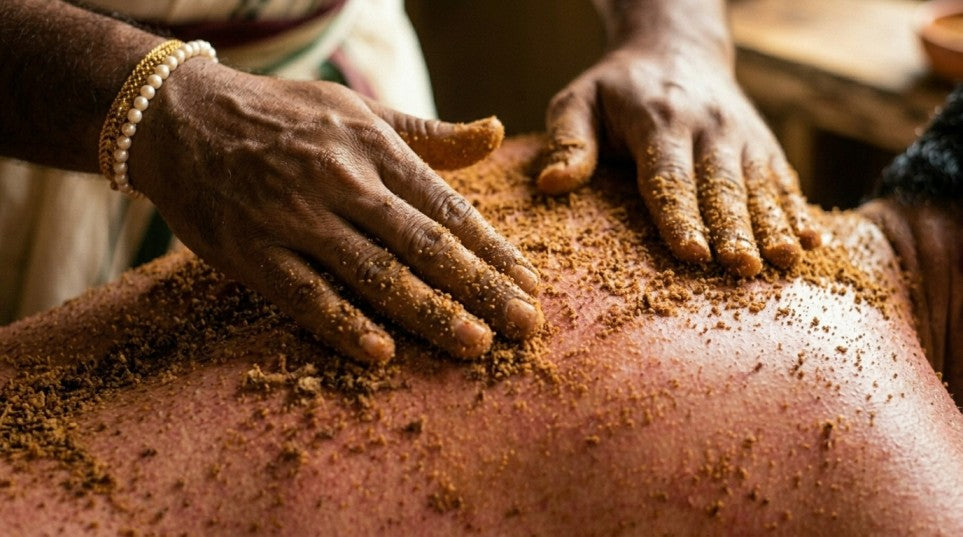
The ghee softens and mobilises the Ama and Pitta-toxins that have been lodged in the liver and bloodstream, pulling them toward the digestive tract where they can be expelled. You also receive daily Abhyanga and steam therapy to loosen toxins from the skin and muscle layer.
-
On the day determined by your doctor (when the internal oleation is complete), you take a specific herbal purgative medicine, most commonly Trivrith Leha, a classical Ayurvedic preparation.
-
This triggers controlled purgation over approximately 4 to 8 hours. The purgation expels the accumulated Pitta-Ama from the liver, gallbladder, and intestinal channels in a structured sequence. The procedure is supervised throughout.
-
This is not like food poisoning or a bad stomach. Patients who have completed Virechana consistently describe the post-procedure state as one of unusual lightness, clarity, and a sense that something genuinely heavy has been lifted. Most patients sleep deeply that night.
-
Diet is reintroduced gradually, starting from warm liquids and progressing to light solid food over five days. Blood-purifying Rasayana herbs are introduced: Manjistha, Neem, Khadira, and Guduchi, the classical medicines for clearing Ama from the blood and skin channels. The skin response to Virechana continues to develop during this recovery phase and the weeks that follow.
How Virechana Clears the Skin: The Simple Explanation
Here is what happens after Virechana, in simple steps:
-
The liver is cleared: The Pitta-Ama that was overloading the liver's processing capacity is expelled. The liver can now efficiently clear inflammatory hormones, metabolic waste, and the toxic byproducts that were being pushed into the blood.
-
The blood becomes cleaner: With the liver functioning properly, the blood is cleared of the inflammatory load that was irritating the skin. The 'fire' in the blood that was driving the skin reaction cools down.
-
The skin has nothing left to push out: The skin's role as a secondary elimination channel is no longer needed. The redness, scaling, and eruptions reduce because the underlying driver, toxic, inflammatory blood, has been removed.
-
Rasayana rebuilds clean tissue: The blood-purifying herbs introduced after Virechana nourish the cleared channels with clean, anti-inflammatory compounds that support new, healthy skin cell production.
This is why Virechana produces a quality of skin clearing that topical treatment cannot, it works from the inside out.
What to Expect: Timeline of Skin Improvement After Virechana
-
Week 1 (during and immediately after): Many patients notice reduced redness and itching within the first week. The skin may initially look slightly worse as the mobilised toxins complete their exit, this is a normal and expected transitional phase.
-
Weeks 2-3: Plaque thickness reduces. In psoriasis, scaling becomes less adherent and plaques begin to thin. In eczema, the acute inflammatory phase resolves.
-
Weeks 4-6: Significant clearing in most patients. The skin has a different quality, less reactive, less hot, and more stable. Flare-ups from food triggers become less intense.
-
Months 2-3: With sustained Rasayana, dietary compliance, and a maintenance course of Panchakarma at the season change, many patients achieve prolonged remission, skin that remains clear without ongoing medication.
Skin Conditions That Respond to Virechana
| Condition | Why Virechana Helps | What Patients Typically Report |
|---|---|---|
| Plaque Psoriasis | Clears Pitta-Ama from blood; reduces immune overactivation; removes the toxic fuel for plaque formation | Reduced scaling and plaque thickness within 3–4 weeks; fewer flare-ups in subsequent months |
| Chronic Eczema | Reduces inflammatory blood load; clears liver; Rasayana nourishes compromised skin barrier | Reduced itching and weeping; improved skin barrier quality; less reactivity to triggers |
| Hormonal Acne | Restores liver oestrogen clearance; reduces inflammatory androgen excess; clears Pitta from blood | Reduction in deep cystic breakouts; improved skin tone; fewer perimenstrual flares |
| Urticaria (hives) | Reduces the hypersensitive immune state in the blood that triggers hive eruptions | Reduced frequency and severity of hive episodes; better tolerance to previous triggers |
| Chronic itching (Vicharchika) | Clears the Pitta-Kapha toxic pattern in blood and skin channels driving chronic itch | Reduction in background itch and scratch-break-itch cycle within 2 weeks |
Final Thoughts
Every cream, every antihistamine, every steroid has been treating the result rather than the cause. Virechana treats the cause, the inflamed, toxin-loaded blood that is driving your skin reaction, and gives the skin the clean internal environment it needs to recover and stay recovered.
Frequently Asked Questions
Q. Will Virechana make my skin worse before it gets better?
A. Some patients experience a brief intensification of their skin condition in the first 3 to 5 days after purgation. This is a normal part of the process — it represents the last of the mobilised toxins completing their exit from the skin channels. It is short-lived and followed by clear improvement. Your Yuvrit doctor will explain what to expect for your specific skin type.
Q. Is Virechana safe for eczema patients who are currently on steroids?
A. Virechana can be safely performed alongside most topical steroids. The programme is typically designed to progressively reduce steroid dependence as the skin responds to the internal detoxification. Your doctor will coordinate with your dermatologist if you are on systemic immunosuppressants. Abrupt cessation of any medication is never recommended without clinical supervision.
Q. How often should Virechana be done for chronic skin conditions?
A. For established conditions like psoriasis or chronic eczema, most patients benefit from one full Virechana course (14–21 days) followed by a seasonal maintenance course once per year — ideally at the start of spring (when Pitta begins to accumulate) or autumn (when the skin is most vulnerable to transitions). Between courses, blood-purifying Rasayana herbs are taken continuously.
Q. Can Virechana be done at home?
A. The preparation and recovery phases can be partially managed at home with clinical guidance. The purgation day itself requires clinical supervision — the dose of purgative medicine, the monitoring of the purgation episodes, and the assessment of completion all require a trained doctor. Attempting Virechana without clinical supervision is not safe or effective.
Related post
27
Apr
24
Apr
24
Apr
