 Free & discreet shipping on all prescriptions
 No insurance required


April 10, 2026
Panchakarma Treatment for PCOS
Ayurveda, the ancient system of natural healing, has been practiced for thousands of years in India. Its holistic approach to health focuses on balancing the mind, body, and spirit through natural remedies, diet, lifestyle adjustments, and therapies. In this post, we’ll explore the core principles of Ayurveda and how you can incorporate them into your daily routine for a healthier and more balanced life.
You know this pattern well. You start the birth control pill and your periods regularise, until you stop and the irregularity returns within three months. You take metformin and your insulin numbers improve, but the weight does not shift and the acne persists. You cut sugar, exercise daily, take inositol supplements, and see modest improvement for a while. Then a stressful period at work, a disrupted sleep pattern, a few months of inconsistency, and the symptoms are back exactly as they were.
This cycle is not a failure of willpower or discipline. It is the natural result of treating the downstream effects of PCOS without addressing the upstream conditions that produce them. Conventional medicine manages PCOS because it does not yet have a framework for resolving it. Ayurveda does.
In Ayurvedic understanding, PCOS is not a disease of the ovaries. It is a systemic condition, the ovarian manifestation of deeper imbalances in digestion, metabolic function, tissue nourishment, and the channels through which reproductive hormones are produced and circulated. Until those upstream imbalances are corrected, the downstream symptoms will continue to return.
This is the clinical logic behind Panchakarma treatment for PCOS: not suppression of symptoms, but resolution of root causes.
How Ayurveda Understands PCOS
Every Ayurvedic article on PCOS mentions Kapha and Vata imbalance. Very few explain what that actually means clinically, or why it produces the specific constellation of symptoms that PCOS creates. Understanding this is essential for appreciating why Panchakarma is not just a supportive therapy, it is the most logical treatment available.
The Kapha Dimension: Accumulation and Obstruction
Kapha governs structure, heaviness, lubrication, and the accumulation of substance in the body. In its balanced state, Kapha provides the physical medium in which the reproductive system operates, the follicular fluid, the uterine lining, and the moisture of the reproductive channels. When Kapha accumulates in excess, driven by a sedentary lifestyle, a diet heavy in refined carbohydrates and dairy, and poor digestive efficiency, it creates sluggishness throughout the system.
In the reproductive channels (Artavavaha srotas), excess Kapha manifests as the classic PCOS picture: the ovaries become heavy and cyst-laden, follicles form but fail to mature and release, the menstrual cycle becomes irregular or absent, weight accumulates particularly around the abdomen and hips, the skin becomes oily and prone to acne, energy is persistently low, and the body develops resistance to insulin.
Kapha-dominant PCOS is the most common presentation, particularly in women with a history of poor dietary habits or a Kapha-predominant constitution.
The Vata Dimension
Vata governs movement, rhythm, communication, and the signalling pathways of the nervous and endocrine systems. The menstrual cycle is, at its core, a precisely timed rhythmic sequence, the coordinated rise and fall of oestrogen, LH, progesterone, and FSH in a specific pattern that governs follicular maturation, ovulation, and uterine preparation. This rhythm is Vata's domain.
When Vata becomes disturbed through chronic stress, irregular sleep and meal timing, excessive travel, over-exercise, emotional instability, or a highly stimulating lifestyle, it disrupts this hormonal rhythm at the signalling level.
The Pitta Dimension
Pitta governs heat, transformation, metabolic activity, and the biochemical conversions that produce hormones from precursors. When Pitta is aggravated, through a diet high in spicy or fermented foods, alcohol, chronic anger or frustration, excessive sun exposure, or hormonal contraceptive use, it creates inflammatory conditions throughout the body and specifically in the hormonal pathways.
Pitta-dominant PCOS is characterised by elevated androgens (particularly testosterone and DHEA-S), inflammatory acne on the jawline and chin, scalp hair thinning, a warm and sensitive scalp, intense premenstrual irritability, elevated inflammatory markers like CRP, and a history of gut inflammation.
PCOD vs. PCOS: The Clinical Distinction
The terms PCOD (Polycystic Ovarian Disease) and PCOS (Polycystic Ovary Syndrome) are often used interchangeably, but they are not identical. PCOD refers specifically to the ovarian finding, ovaries that contain multiple small follicular cysts, which can occur without significant hormonal disruption and is often manageable through lifestyle changes alone. PCOS is the full endocrine syndrome: hormonal imbalance, androgen excess, metabolic dysfunction, and systemic inflammation are all part of the picture, and management requires a deeper and more sustained intervention.
From an Ayurvedic perspective, PCOD corresponds more closely to a Kapha-Vata srotorodha (channel blockage) without deep systemic involvement, while PCOS typically includes Pitta aggravation and significant Agni impairment affecting the Rasa and Rakta dhatus. The therapeutic approach is similar but the depth and duration of Panchakarma intervention differs. Ayurveda doctors assess both dimensions during the initial consultation. The metabolic overlap between PCOS and Type 2 Diabetes, specifically the shared mechanism of insulin resistance, is addressed within the same Ayurvedic framework, and patients with both conditions benefit from a coordinated treatment protocol.
Why Panchakarma works for PCOS
Panchakarma reaches into the deep channels of the body and physically clear the accumulated Ama and dosha imbalances that have lodged there. Internal medicines work at the dhatu (tissue) level from the inside. Panchakarma accesses and cleanses the channels themselves, the Artavavaha srotas (reproductive channels), the Medovaha srotas (fat and metabolic channels), and the annavaha srotas (digestive channels) that are all implicated in PCOS. This is the level at which lasting change is possible.
Critically, Panchakarma is not a standard protocol administered identically to every patient. The selection, sequencing, duration, and intensity of each therapy are determined by the treating doctor based on the individual patient's dosha constitution, the specific PCOS presentation, the degree of Ama accumulation, and any co-existing conditions. This personalisation is what separates a genuine clinical Panchakarma programme from a generic wellness package.
Key Panchakarma Therapies for PCOS
The following therapies are the most commonly prescribed in a Panchakarma protocol for PCOS. Not every patient receives all of them, the combination is determined by the doctor based on the individual assessment.
Virechana
Virechana is the primary Pitta-eliminating procedure in Panchakarma, and it is the cornerstone of treatment for inflammatory and androgen-dominant PCOS presentations. Through a precisely administered herbal purgation, Virechana clears the liver, small intestine, and associated channels of accumulated toxins.
For PCOS specifically, this is clinically significant in several ways. The liver is the primary site of oestrogen metabolism, when it is burdened with excess Pitta and toxic accumulation, oestrogen is not cleared efficiently, contributing to hormonal dysregulation. Virechana directly restores hepatic channel clarity, improving the body's ability to metabolise and eliminate excess hormones. It also dramatically reduces the inflammatory load, lowering androgen levels, clearing acne from within, and reducing the systemic inflammation that perpetuates the PCOS cycle. Most patients report noticeable skin clearing and a significant reduction in acne within two to four weeks following Virechana.
Vasti
Vasti is the most important single therapy for irregular menstrual cycles and Vata-dominant PCOS, and it is described in classical Ayurvedic texts as the most powerful Vata-pacifying intervention available. The menstrual cycle is governed by Apana Vata, the downward-moving form of Vata that governs elimination, menstruation, ovulation, and childbirth. When Apana Vata is disturbed, the cycle loses its rhythm.
Two types of Vasti are used in PCOS protocols: Anuvasana Vasti (medicated oil enema) nourishes and lubricates the pelvic tissues, restoring the unctuous quality that Vata requires to function in its rhythmic pattern. Kashaya Vasti (decoction-based enema) cleanses the colon of accumulated Vata-aggravating Ama and directly regulates the Apana Vata that governs the cycle. The anatomical proximity of the colon to the uterus and ovaries makes this route of administration uniquely effective for reproductive conditions.
For women with PCOS-related infertility, a structured Basti sequence, often a series of 8 to 16 alternating oil and decoction enemas, is the primary treatment for restoring ovulatory function. It is combined with Virechana and internal Rasayana herbs to create a comprehensive reproductive rejuvenation protocol.
Udwartanam
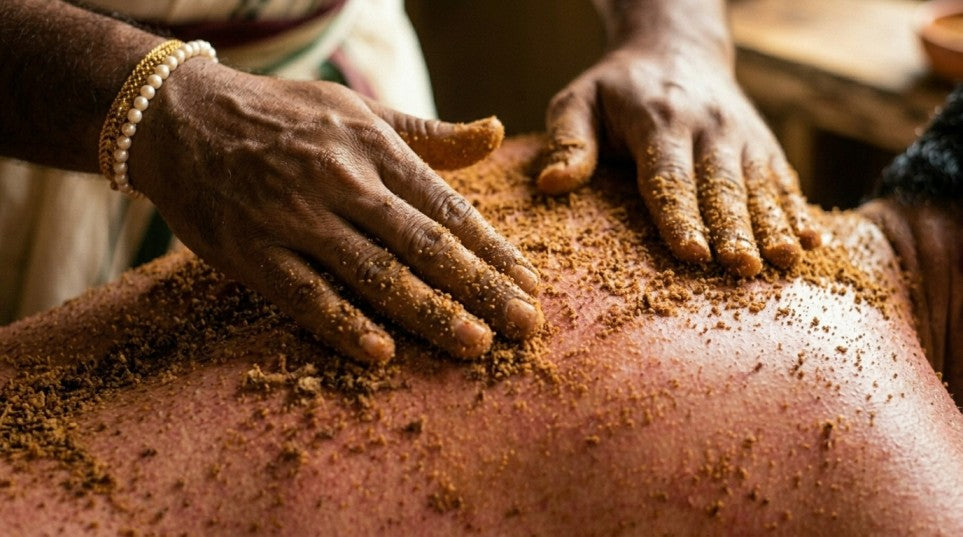
Udwartanam is a vigorous, deep-pressure massage performed with specially formulated dry herbal powders rather than oil. It is one of the most effective therapies for Kapha-dominant PCOS and is essential for patients where weight gain, insulin resistance, sluggish metabolism, and subcutaneous fat accumulation are primary presentations.
The mechanical action of Udwartanam combined with the specific Kapha-reducing, metabolism-stimulating properties of the herbs used (typically combinations including Triphala, Musta, and Kola) directly breaks down subcutaneous fat deposits, stimulates lymphatic drainage, reduces tissue heaviness, improves peripheral insulin sensitivity, and activates the metabolic fire that Kapha excess has suppressed. Patients undergoing Udvartana as part of a PCOS protocol consistently report improved energy, reduced bloating, and measurable metabolic improvements, even before significant weight change occurs.
Abhyanga (Medicated Oil Massage) and Swedana (Herbal Steam)
Abhyanga and Swedana together form the preparatory foundation (Purvakarma) for any Panchakarma programme and are also administered as standalone therapies within the main phase. Abhyanga with warm medicated oils loosens Ama from its deep tissue lodgement, opens the channels, improves circulation throughout the pelvis and reproductive organs, and has a profound calming effect on the nervous system, reducing the cortisol output that drives Vata-dominant cycle disruption.
Swedana (medicated steam) follows Abhyanga, using the heat to further liquefy Ama, open the skin's microchannels, and drive the medicated oils deeper into the tissues. Together, they prepare the body for the deeper cleansing procedures of Virechana and Basti, and independently they reduce inflammation, improve pelvic circulation, and support the nervous system throughout the treatment programme.
Nasya
Nasya is perhaps the most underappreciated therapy in the Ayurvedic PCOS toolkit, and the one that most directly addresses the neurological root of hormonal dysregulation. In classical Ayurveda, the nasal passage is described as the gateway to the brain, and specifically to the Adhipati marma, the energy centre that governs the entire endocrine cascade.
In physiological terms, medicated oils administered through the nasal passages cross the blood-brain barrier with unusual efficiency via the olfactory and trigeminal nerve pathways, reaching the hypothalamic and pituitary regions directly. The hypothalamic-pituitary-ovarian (HPO) axis, the master regulatory circuit for the menstrual cycle and ovulation, sits at precisely this anatomical location. In PCOS, the pulsatile release of GnRH (the hypothalamic signal that initiates the entire ovulatory cascade) is dysregulated. Nasya with specific medicated oils directly influences this circuit, helping to restore the rhythmic GnRH pulsatility that triggers normal LH and FSH secretion and, ultimately, ovulation.
This is the one therapy in the PCOS protocol that works at the neuroendocrine level, addressing the HPO axis dysfunction that is central to the condition, rather than simply managing its downstream consequences.
Shirodhara
For the significant proportion of PCOS patients in whom chronic stress is a primary driver, or a significant amplifier, of their hormonal dysregulation, Shirodhara is an essential component of the protocol. The sustained, rhythmic flow of warm medicated oil across the Ajna marma (the forehead, corresponding to the pituitary region) activates the parasympathetic nervous system, reduces cortisol output, and interrupts the chronic stress → HPA axis dysregulation → anovulation cycle.
It is worth noting that this same neurological mechanism makes Shirodhara highly effective for hormonal migraine, one of the most common PCOS co-occurrences. Women who experience migraines that worsen premenstrually or are triggered by hormonal fluctuations often find that the same Panchakarma programme that addresses their PCOS also significantly reduces their migraine frequency.
How Panchakarma Interrupts the PCOS Cycle
PCOS is not a single hormonal problem. It is a cascade, a self-reinforcing loop in which each dysfunction amplifies the others. Understanding where in this cascade each Panchakarma therapy intervenes helps clarify why the full protocol produces more durable results than any single intervention.
| Dysfunction in the PCOS Cascade | Ayurvedic Understanding | Panchakarma Intervention |
|---|---|---|
| Ama in the liver impairs oestrogen metabolism | Pitta-dominant Ama blocking Yakrit (liver) channels | Virechana clears hepatic channels |
| Elevated cortisol suppresses GnRH pulsatility | Chronic stress aggravates Vata via HPA axis | Shirodhara and Nasya recalibrate HPA axis |
| Insulin resistance drives androgen production | Kapha-driven Agni impairment and Meda dhatu excess | Udvartana + Kashaya Basti + dietary protocol |
| Blocked reproductive channels prevent follicle maturation | Ama in Artavavaha srotas obstructs follicular development | Basti sequence clears the channel |
| Chronic inflammation elevates androgens and CRP | Pitta aggravation driving systemic Rakta dushti | Virechana and anti-inflammatory internal herbs |
| Dysregulated LH/FSH ratio prevents ovulation | Vata disruption of neuroendocrine rhythm | Nasya + Basti sequence restores rhythmic signalling |
This cascade explains why treating only one element, suppressing androgens with medication, or reducing inflammation with diet alone, produces only partial and temporary results. Panchakarma addresses the cascade at multiple points simultaneously, which is why patients who complete a full programme experience a qualitatively different level of improvement than those who use single-modality approaches.
PCOS Manifestations That Panchakarma Addresses Comprehensively
One of the most important things to understand about PCOS is that it is not a single-symptom condition. Most women present with a cluster of issues, hormonal, metabolic, dermatological, psychological, and reproductive, that are all expressions of the same underlying imbalance. This is precisely why Panchakarma is so well suited to PCOS: as a systemic intervention, it addresses the full cluster rather than each symptom in isolation.
-
Irregular or Absent Periods - Primary target of the Basti sequence and Virechana. Restoring Apana Vata function and clearing the reproductive channels is the foundational step. Most patients notice measurable cycle regularisation within the first two to three months following a Panchakarma programme.
-
Acne and Inflammatory Skin - Driven by Pitta aggravation and androgen excess. Virechana is the primary treatment, combined with internal anti-Pitta herbs (Manjistha, Lodhra, Neem). The skin is downstream of the liver and blood (Rakta dhatu), clearing the liver through Virechana reliably improves inflammatory acne within four to six weeks.
-
Hair Fall and Scalp Thinning - PCOS-driven hair fall involves both DHT-mediated follicle miniaturisation (androgen component) and stress-driven telogen effluvium (cortisol component). Abhyanga with Bhringraj and Brahmi oils, Nasya, and the systemic hormone-balancing effect of the full Panchakarma programme together address both drivers. Internal herbs including Shatavari and Bhringraj capsules support the follicular rebuilding process.
-
Weight Gain and Insulin Resistance - Kapha-driven accumulation in the Meda dhatu (fat tissue) combined with impaired Agni. Udvartana is the primary therapy, supported by Lekhana Basti (a specific type of Kashaya Basti designed for reducing excess Meda) and a Kapha-reducing dietary protocol. Improving Agni through Panchakarma also directly improves insulin sensitivity, as the two are functionally related in Ayurvedic physiology.
-
PCOS-Related Infertility - PCOS is the most common cause of ovulatory infertility. A full Panchakarma programme focused on reproductive rejuvenation, combining Virechana, the Basti sequence, Nasya, and Rasayana (tissue-rebuilding) herbs, is designed to restore ovulatory function by clearing the reproductive channels, recalibrating the HPO axis, and nourishing the follicular environment. This is one of the most important and most successful applications of Ayurvedic treatment.
-
Uterine Fibroids and Co-Occurring Reproductive Conditions - Many women with PCOS also present with uterine fibroids, the shared driver is oestrogen dominance, which is both a consequence of impaired liver clearance and a result of the androgen-to-oestrogen conversion that elevated androgens produce. The Panchakarma protocol for PCOS that includes Virechana and channel-clearing therapies also addresses the oestrogen dominance environment that promotes fibroid growth.
-
Mood Instability, Anxiety, and Low Energy - The psychological burden of PCOS, chronic anxiety, mood swings around the cycle, persistent fatigue, low self-esteem, is driven by a combination of hormonal dysregulation and chronic stress activation of the nervous system. Shirodhara, Abhyanga, and internal Medhya (nervine) herbs such as Brahmi, Shankhpushpi, and Ashwagandha are the primary tools for this dimension. Patients consistently rate the improvement in emotional wellbeing as one of the most significant outcomes of a Panchakarma programme.
-
Skin Conditions Exacerbated by PCOS - The systemic inflammation of PCOS frequently exacerbates psoriasis and eczema in women who have a predisposition to these conditions. The androgen-driven increase in sebum production, combined with impaired skin barrier function and elevated inflammatory cytokines, creates an environment in which both conditions flare more frequently and more severely. Virechana's systemic anti-inflammatory and liver-clearing effect addresses the hormonal inflammation that drives these flares, making the PCOS Panchakarma protocol useful for skin conditions as well.
Final thoughts
PCOS is one of the most prevalent and most undertreated conditions affecting women in India today. The conventional medical system manages its symptoms and does so with tools that are useful in the short term. But sustained resolution, the restoration of a regular cycle and genuine hormonal balance, requires the kind of root-cause treatment that Ayurveda has been providing for thousands of years.
Panchakarma treatment for PCOS is not a gentle spa programme. It is a clinically structured, doctor-led intervention that addresses the digestive impairment, toxic accumulation, channel blockage, and neuroendocrine dysregulation that produce PCOS, simultaneously, systemically, and in the precise sequence that allows deep and lasting change.
Frequently Asked Questions
Q. How long does Panchakarma take to regulate periods in PCOS?
A. Most patients notice the first measurable improvement in cycle regularity within four to six weeks of completing the main Panchakarma programme. A complete cycle is typically restored, or significantly improved within two to three cycles following the programme. Patients with long-standing, severe PCOS (absent periods for years, or very long cycles) may require two sequential Panchakarma courses over six to twelve months to achieve stable cycle regularity.
Q. Can Panchakarma help me conceive with PCOS?
A. Yes, and it is one of the most important applications of Ayurvedic treatment for PCOS. By restoring ovulatory function through reproductive channel clearing, HPO axis recalibration, and hormonal tissue nourishment, a properly structured Panchakarma programme significantly improves the probability of natural conception. Many women who have been unsuccessful with IUI or are seeking to avoid IVF find that a dedicated fertility-focused Panchakarma programme followed by consistent herbal support produces results within three to six months. Your Yuvrit doctor will assess your specific fertility picture and advise on realistic expectations.
Q. Is Panchakarma safe during PCOS if I have irregular or heavy bleeding?
A. Yes, with appropriate modification. Active heavy bleeding (menorrhagia) is a contraindication for Virechana during the bleeding phase, but the programme is structured around the cycle and modified accordingly. Basti, Abhyanga, and Shirodhara can be continued safely regardless of cycle phase. Your Yuvrit doctor will schedule and adjust procedures based on your current cycle status throughout the programme.
Q. What is the difference between Panchakarma for PCOS and for PCOD?
A. PCOD without significant systemic hormonal disruption typically responds to a shorter, less intensive Panchakarma programme, often 7 to 14 days followed by herbal support and dietary modification. PCOS with significant androgen excess, insulin resistance, chronic anovulation, or infertility requires a more comprehensive intervention: typically 14 to 21 days of intensive Panchakarma, followed by six to twelve months of sustained herbal and lifestyle management. The distinction is determined through the initial clinical assessment.
Q. Can PCOS be cured permanently with Ayurveda?
A. Ayurveda offers the most comprehensive framework for achieving sustained remission from PCOS, a state where the condition is not merely managed but resolved at the level of its root causes. Whether this constitutes a permanent cure depends on ongoing diet and lifestyle maintenance. Patients who complete a full Panchakarma programme and maintain the recommended dietary and lifestyle principles consistently find that their PCOS symptoms resolve and do not return. Patients who return to the dietary and lifestyle patterns that originally produced the imbalance will typically see symptoms return over time. The honest answer is: Ayurveda can produce lasting freedom from PCOS, but it requires commitment to the conditions that support that freedom.
Q. How many Panchakarma sessions are needed for PCOS?
A. A standard Panchakarma programme for PCOS involves 14 to 21 consecutive therapy days, typically followed by a maintenance programme of 7 to 10 days three to six months later. Within the main programme, the number of individual procedure sessions varies — the Basti sequence alone involves 8 to 16 sessions over the programme period. Your Yuvrit doctor will specify the precise schedule based on your assessment.
Related post
27
Apr
24
Apr

24
Apr
