 Free & discreet shipping on all prescriptions
 No insurance required


April 27, 2026
Ayurvedic Diet for Acid Reflux
Ayurveda, the ancient system of natural healing, has been practiced for thousands of years in India. Its holistic approach to health focuses on balancing the mind, body, and spirit through natural remedies, diet, lifestyle adjustments, and therapies. In this post, we’ll explore the core principles of Ayurveda and how you can incorporate them into your daily routine for a healthier and more balanced life.
Acid reflux has a familiar pattern. The burning rises after a heavy meal, a spicy dinner, a late night, or a stressful day at work. You reach for an antacid, and the burning stops for a few hours. Then it comes back. And the burning continues, quietly, in the background of daily life.
The problem with antacids and PPIs is that they treat the symptom, too much acid in the wrong place, without asking why the digestive system is generating excessive acid, why the valve between the stomach and oesophagus is not closing properly, and why the problem keeps returning every time the medication is reduced.
Ayurveda asks these questions first. In Ayurveda, acid reflux is not primarily a medication problem. It is a Pitta problem, the fire element of the digestive system has become excessive and erratic. The dietary approach focuses on reducing the conditions that keep generating excess acid, not just neutralising the acid that has already been produced.
Ayurvedic approach to GERD and acid reflux begins with this root-cause understanding. Diet is the most impactful tool, and the most consistently underused one.
How Ayurveda Understands Acid Reflux
In Ayurveda, acid reflux is described as Amlapitta, Amla means sour or acid, and Pitta is the fire element that governs digestion. Amlapitta is what happens when digestive fire (Agni) becomes imbalanced: instead of producing the controlled, appropriate amount of acid needed for digestion, it becomes excessive and erratic. The excess acid (Pitta) then moves upward in the digestive tract, driven by aggravated Vata, rather than staying in the stomach where it belongs.
This is exactly what modern gastroenterology describes: the lower oesophageal sphincter (the valve at the top of the stomach) fails to close properly, and acid flows upward into the oesophagus. Ayurveda describes the same mechanism in different languages: Vata (the energy of movement) has become reversed in the upper digestive tract, driving Pitta (acid) in the wrong direction.
The two dosha drivers of acid reflux
-
Pitta: the fire that is generating too much acid. When Pitta is aggravated, the digestive fire becomes excessive. The stomach produces more acid than the digestive process requires. This excess acid has nowhere to go but upward. Pitta-aggravating triggers include spicy food, alcohol, coffee, sour and fermented foods, excessive salt, and the heat and intensity of stress, anger, and overwork.
-
Vata: the movement that pushes the acid in the wrong direction. Normally, peristalsis and the oesophageal sphincter work together to ensure that stomach contents move downward. When Vata becomes erratic from irregular meal timing, eating too fast, skipping meals, or chronic anxiety, the downward directional flow of digestion is disrupted, and acid moves upward instead.
The combination of excess Pitta (too much acid) and disturbed Vata (wrong direction of movement) produces the full picture of acid reflux: the burning, the regurgitation, the sour taste, the hoarseness, and the chronic irritation of the oesophagus.
Why the same person often has acid reflux and constipation
This is the most clinically important observation that competitor articles on acid reflux consistently miss. Acid reflux and constipation co-occur far more frequently than chance would suggest, and the reason is straightforward in Ayurveda. Both are Vata disorders affecting the movement of the digestive system.
When Apana Vata (the downward-moving energy that governs bowel movements) is disturbed, elimination is impaired. The backpressure from a sluggish colon pushes upward through the entire GI tract, contributing to acid reflux at the upper end. Many patients who resolve their constipation through Ayurvedic treatment find their acid reflux simultaneously improves, because both conditions share the same Vata root.
Foods That Aggravate Acid Reflux
Foods that directly aggravate Pitta (increase acid production)
-
Spicy food and chilli: The most obvious trigger. Chilli, capsaicin, and very pungent spices directly increase Pitta-Agni in the stomach, stimulating excess acid production. Note: gentle warming spices like ginger, cumin, and coriander in moderate amounts are not only tolerated but beneficial, they support digestion without aggravating Pitta.
-
Alcohol: The most potent single dietary Pitta aggravator. Alcohol directly increases gastric acid secretion, relaxes the lower oesophageal sphincter (making reflux mechanically easier), and impairs the liver's ability to process the inflammatory metabolites of excess Pitta. Even small amounts of alcohol consistently worsen acid reflux in Pitta-constitution patients.
-
Coffee and strong tea: Caffeine relaxes the lower oesophageal sphincter, reduces the pressure differential that keeps acid in the stomach, and directly stimulates gastric acid secretion. The temporary relief that a morning coffee seems to provide (by stimulating bowel movement) is more than offset by its acid-generating effect in the stomach. Shifting to herbal teas like fennel, coriander, or licorice removes this daily acid trigger.
-
Sour, fermented, and vinegar-based foods: Sour taste is inherently Pitta-aggravating in Ayurveda. Fermented foods (although beneficial for gut microbiome in general) are consistently aggravating for patients with active acid reflux because their organic acid content adds to the existing Pitta excess. This includes curd/yoghurt at night, pickles, sour buttermilk, and vinegar dressings.
-
Tomatoes and citrus fruits in excess: Both are sour and heat-producing. Tomato-heavy foods (particularly cooked tomato sauces, which concentrate the acidity) are one of the most consistent acid reflux triggers in clinical practice. Raw tomatoes in salads are less aggravating than cooked tomato preparations.
-
Fried and oily foods: These slow gastric emptying the stomach takes longer to process them, and the resulting prolonged acid exposure is a direct contributor to reflux. They also relax the oesophageal sphincter. The combination of delayed gastric emptying and an open sphincter is the mechanical recipe for acid reflux.
-
Late night eating: When you lie down within 2 to 3 hours of a meal, gravity no longer helps keep stomach contents in the stomach. The full stomach, combined with the horizontal position, creates the physical conditions for reflux regardless of what was eaten. Dinner should be eaten at least 3 hours before lying down, ideally before 7:30 pm.
The Viruddha Ahara (food incompatibility) factor
Ayurveda identifies specific food combinations that create Ama (toxic metabolic residue) and excessive Pitta in the digestive system, not through any single food's properties, but through the incompatibility of combining two foods together. The most common clinically relevant incompatibilities for acid reflux:
-
Milk with salt: Extremely common in Indian cuisine, think salted lassi, milk in salty chai, or milk-based curries with salt. This combination creates Ama directly and is specifically listed in classical texts as a cause of skin conditions and digestive disorders.
-
Fruit with grains or dairy: Fruit digests quickly. Grains and dairy digest slowly. Eating them together means the fruit sits in the stomach waiting for the grains to digest, fermenting in the warmth of the stomach and generating the sour, acidic byproducts that worsen reflux. This is why fruit should ideally be eaten alone or between meals, not with main meals.
-
Curd at night: Curd (yoghurt) is both sour and heavy. At night, Agni is at its lowest and the digestive system is least capable of processing heavy, sour foods. Curd at night is one of the most consistently Pitta-aggravating and Ama-generating practices in the urban Indian diet.
Foods That Cool and Heal Acid Reflux
The right foods for acid reflux are cooling, sweet, bitter, and astringent, the three tastes that directly reduce Pitta. Here is the practical food-by-food guide:
Best grains
-
White rice (not brown): Cooling, easy to digest, and specifically recommended for Pitta conditions. Brown rice is harder to digest and can worsen reflux in acute presentations. Old rice (stored for more than a year) is the most beneficial.
-
Wheat and oats: Both are cooling and sweet, appropriate for acid reflux. Oats with warm milk (not cold) as a morning meal is one of the most Pitta-pacifying breakfast options.
-
Avoid: Corn and maize in excess, these are heating and can worsen Pitta. Also avoid puffed and dry roasted grains in acute phases.
Best vegetables
-
Bottle gourd (lauki/dudhi): One of the most cooling vegetables in Ayurveda. Specifically recommended for Pitta conditions including acid reflux. Lauki juice (plain, without salt or lemon) in the morning is a classical Pitta-reducing home remedy.
-
Ash gourd (petha), ridge gourd, and snake gourd: All cooling gourds that are easy to digest and specifically Pitta-pacifying.
-
Drumstick (moringa): Bitter and cooling, directly reduces Pitta and supports liver function, which is relevant for the inflammatory Pitta component of chronic GERD.
-
Cucumber and coriander: Both cooling and specifically recommended for excess Pitta. Fresh coriander chutney is one of the simplest and most effective Pitta-reducing condiments.
-
Avoid: Raw onions and garlic (pungent and heating), green chillies, raw tomatoes in excess, brinjal (aubergine) in acute phases.
Best fruits
-
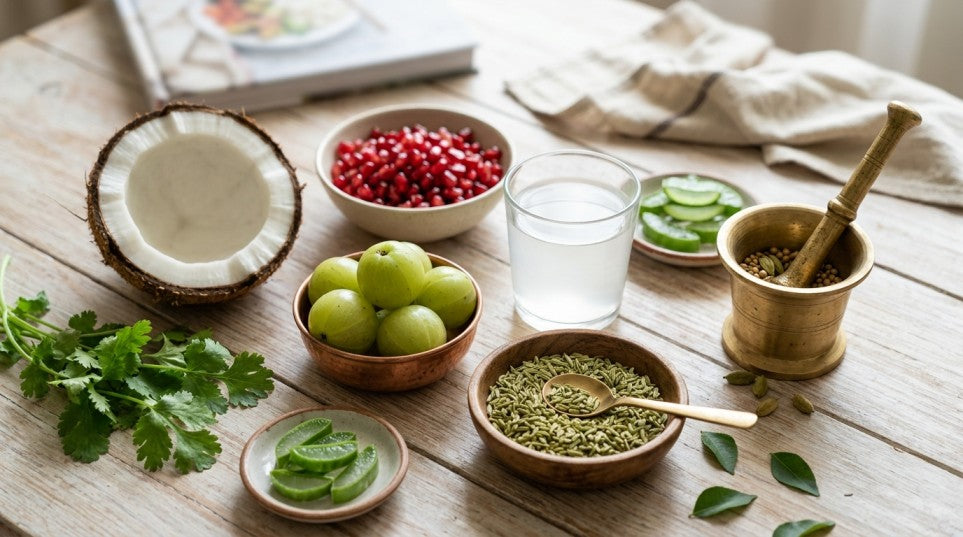
Pomegranate: Despite being slightly astringent, pomegranate is specifically cooling and Pitta-reducing. It has a direct calming effect on gastric inflammation. Fresh pomegranate juice (unsweetened, without salt) is one of the most beneficial drinks for acid reflux.
-
Sweet mango (ripe): Sweet, cooling, and nourishing. Ripe mango in season is one of the best fruits for Pitta constitutions, unlike raw mango, which is sour and aggravating.
-
Ripe sweet grapes, watermelon, and melon: All cooling and hydrating, directly reduce Pitta heat.
-
Amla (Indian gooseberry): This is the most important single food for acid reflux in Ayurveda. Despite being sour, amla's overall action is Pitta-reducing, it has a unique combination of sour taste with sweet post-digestive effect that reduces the Pitta fire rather than feeding it. A teaspoon of fresh amla juice or amla powder with water each morning directly reduces gastric acidity over time.
-
Avoid: Sour citrus fruits (oranges, lemons in excess), raw unripe mango, tamarind, and very sour fruits in the acute phase.
Specific herbs and home remedies that work
-
Fennel seeds (saunf): The most accessible and effective home remedy for acid reflux in Ayurveda. Fennel is cooling, carminative, and directly reduces Pitta in the stomach. Chew one teaspoon of raw fennel seeds after every meal. Or make fennel tea: steep one teaspoon of seeds in hot water for 5 minutes. This simple practice, maintained consistently, produces measurable reduction in post-meal acid symptoms within two weeks.
-
Coriander seeds (dhania): Cooling and specifically Pitta-reducing. Coriander seed tea (one teaspoon of seeds boiled in water, cooled to room temperature) is one of the most effective cooling drinks for summer-aggravated acid reflux.
-
Licorice root (mulethi/yashtimadhu): The most important herbal medicine for the esophageal lining in Ayurveda. Licorice is demulcent (it coats and soothes the oesophageal mucosa that chronic acid has irritated) and directly reduces gastric acid production. A small piece of licorice root chewed or steeped in water provides relief in acute heartburn and, with sustained use, helps repair the damaged oesophageal tissue. Classical Ayurvedic texts list Yashtimadhu (licorice) as the primary herb for Amlapitta.
-
Aloe vera (Kumari): The fresh inner gel of aloe vera is one of the most cooling, anti-inflammatory, and oesophageal-protective substances available. Consume 2 tablespoons of fresh aloe vera inner gel (not the bitter rind) each morning on an empty stomach. Important: use fresh gel from the leaf or a preservative-free preparation, the commercial aloe vera juices often contain citric acid as a preservative, which is itself Pitta-aggravating.
-
Cardamom (elaichi): Cooling and digestive. Chewing one cardamom pod after meals neutralises the post-meal Pitta build-up and freshens the breath that acid reflux often affects.
-
Coconut water: One of the most cooling and alkaline drinks available. Fresh tender coconut water directly reduces gastric acidity within 15 to 20 minutes of consumption and is one of the best immediate-relief drinks for acid reflux episodes.
A Practical Daily Diet for Acid Reflux Patients
| Time | What to Eat / Drink | Why | What to Avoid |
|---|---|---|---|
| On waking (6–7 am) | Warm water + 1 tsp amla powder or fennel seed tea | Reduces overnight Pitta accumulation; cools the stomach before food | Coffee, chai with milk, cold water |
| Breakfast (7:30–8:30 am) | Warm oatmeal with ghee, or soft idli with coconut chutney, or wheat porridge. No citrus, no sour. | Cooling, easy to digest; ghee coats the stomach lining | Upma with tomato, fried breakfast items, fruit juice |
| Mid-morning (10–11 am) | Fresh coconut water or pomegranate juice | Cooling; directly reduces gastric acid | Coffee, sweet lime juice, sour lassi |
| Lunch (12–1 pm) | White rice or wheat roti, moong dal, cooling vegetables (lauki/cucumber/drumstick), fresh coriander chutney, small amount of ghee | Largest meal when Agni is strongest; ghee coats and protects the stomach; cooling vegetables reduce Pitta | Very spicy sambhar, raw onions, tomato-heavy curries |
| Evening (4–5 pm) | Fennel tea or coriander tea, a few dry dates or ripe banana | Prevents the evening hunger that drives poor dinner choices | Chai, fried snacks, salty namkeen |
| Dinner (before 7 pm) | Light meal: moong dal khichdi, or soft rice with a simple vegetable, or wheat roti with lauki sabzi. No curd at night. | Light early dinner with minimum Agni burden; no sour or heavy food at night | Curd, rajma, spicy non-veg, late eating after 8 pm |
How You Eat Matters as Much as What You Eat
This is the section that competitors consistently miss. Ayurveda's understanding of digestion is not just about which foods are good or bad, it is about the conditions under which food is eaten. Pachaka Pitta, the digestive fire in the stomach, functions optimally in a specific physiological state. When that state is disrupted, even good food is incompletely digested and generates Ama.
Eat at the table, without screens
Eating while working, scrolling, or watching a screen activates the sympathetic nervous system (stress mode), which suppresses stomach acid for digestion-preparation activity and instead directs energy away from the GI tract. When you finish the screen time and the parasympathetic system (rest and digest mode) resumes, it produces a surge of digestive activity, including acid secretion on a stomach that is no longer expecting food. This is one mechanism through which stressed, distracted eating produces acid reflux even from foods that would not otherwise be triggered.
Eat until three-quarters full, never completely full
Overeating is the most consistent mechanical cause of acid reflux, because a completely full stomach increases intragastric pressure beyond what the lower oesophageal sphincter can contain. The Ayurvedic principle of eating until three-quarters full (leaving space for one-quarter water and one-quarter air in the stomach) is not just philosophical, it is the practical way to keep stomach pressure below the sphincter's sealing capacity.
Do not lie down for 3 hours after eating
Gravity is the simplest anti-reflux mechanism available. When you are upright, stomach acid stays in the stomach. When you lie down within 2 to 3 hours of eating, acid has immediate access to the oesophagus. Many patients whose acid reflux is predominantly nocturnal burning that wakes them at night, find that simply shifting dinner to 6:30 to 7 pm and staying upright until 10 pm eliminates their nighttime symptoms entirely.
Do not eat when angry, stressed, or emotionally activated
This is the clinical insight most directly supported by Ayurveda's understanding of Sadhaka Pitta, the sub-dosha of Pitta that governs emotional intelligence and the relationship between emotional state and digestive function. Eating a meal during or immediately after a stressful event is one of the most reliable ways to produce acid reflux, because the emotional Pitta amplifies the digestive Pitta, generating excess acid and erratic digestive movement simultaneously.
Warm water after meals, not cold and not ice
Cold water suppresses Agni (digestive fire) and impairs the enzymatic digestion that reduces the fermentation responsible for gas and reflux. Warm water with meals or immediately after them supports digestive function. The habit of taking large amounts of cold water or ice during a restaurant meal is one of the most reliable ways to impair the digestion of whatever you have just eaten.
The Acid Reflux - Migraine - Skin Connection
Saumya Ayurveda's article correctly identifies that acid reflux, migraine, and skin conditions often share the same Pitta root. This is clinically important for Yuvrit's patients to understand: if you have chronic acid reflux and also experience migraines or inflammatory skin conditions like psoriasis or eczema, these are not separate problems requiring separate treatments. They are different expressions of the same underlying Pitta aggravation in the blood and digestive channels.
In Ayurveda, when Pitta is not cleared through the digestive channels, it overflows into the general circulation and lodges in the next available tissue, the skin (producing rashes, psoriasis, and inflammatory conditions) and the nervous system (producing the vascular headache pattern of Pitta-type migraine). This is why patients who address their acid reflux through the Ayurvedic dietary protocol often find simultaneous improvements in their skin and headache pattern, the Pitta fuel for all three conditions has been reduced.
Similarly IBS and bloating frequently co-occur with acid reflux because all three involve Pitta-Vata disruption of the digestive channels. Addressing the Pitta through dietary change and, when needed, Panchakarma, resolves all three as a single systemic picture rather than each requiring a separate intervention.
When Diet Is Not Enough: The Panchakarma Connection
The Ayurvedic diet for acid reflux is the most important ongoing management tool, but for patients with established chronic GERD, longstanding oesophageal irritation, or severe Pitta accumulation, dietary change alone may not be sufficient to produce full resolution. The Pitta-Ama that has accumulated in the liver, small intestinal channels, and oesophageal tissue requires active clearance, which is what Panchakarma provides.
Virechana (therapeutic purgation) is the most specifically indicated Panchakarma procedure for Amlapitta. It clears the accumulated Pitta-Ama from the liver and intestinal channels, removing the source of ongoing excess acid production at its root. Many patients with chronic GERD who have been on PPIs for years find that a Virechana-based Panchakarma programme, combined with the dietary protocol, produces the most significant and lasting reduction in acid symptoms they have experienced.
Final Thoughts
Acid reflux does not have to be managed with antacids for the rest of your life. When the Pitta-generating conditions are systematically removed from the diet, when food incompatibilities are avoided, when meal timing supports rather than disrupts Agni, and when the specific cooling and protective foods are eaten consistently, the digestive fire returns to its natural, appropriate level. The burning stops, the oesophagus heals, and the medication requirement naturally reduces.
The Ayurvedic dietary approach to acid reflux is not a short-term elimination diet. It is a permanent shift in how you eat, one that becomes natural and easy within a few weeks, and that produces improvements not just in your digestion but in your energy, your skin, and your mental clarity.
Related post
27
Apr
24
Apr

24
Apr
