 Free & discreet shipping on all prescriptions
 No insurance required


April 21, 2026
Kati Basti for Lower Back Pain
Ayurveda, the ancient system of natural healing, has been practiced for thousands of years in India. Its holistic approach to health focuses on balancing the mind, body, and spirit through natural remedies, diet, lifestyle adjustments, and therapies. In this post, we’ll explore the core principles of Ayurveda and how you can incorporate them into your daily routine for a healthier and more balanced life.
Lower back pain is the most common musculoskeletal complaint in India, and one of the most consistently undertreated. Not because treatment options are unavailable, but because the available options (NSAIDs, muscle relaxants, steroid injections, physiotherapy) address the pain without addressing what produced it.
Ayurveda approaches lower back pain with a fundamentally different question: what has caused the Vata dosha, which governs the lumbar region as its primary seat, to become disturbed? The dryness, stiffness, and radiating pain of most lower back conditions are the clinical expression of Vata aggravation in the lumbar channels. Kati Basti is the treatment specifically designed to reverse this, by delivering warmth, lubrication, and medicated herbal nourishment to the exact tissue level that Vata has depleted.
Yuvrit's approach to lower back pain begins with this understanding, and Kati Basti is the centrepiece therapy of any lower back programme at the clinic.
What Is Kati Basti?
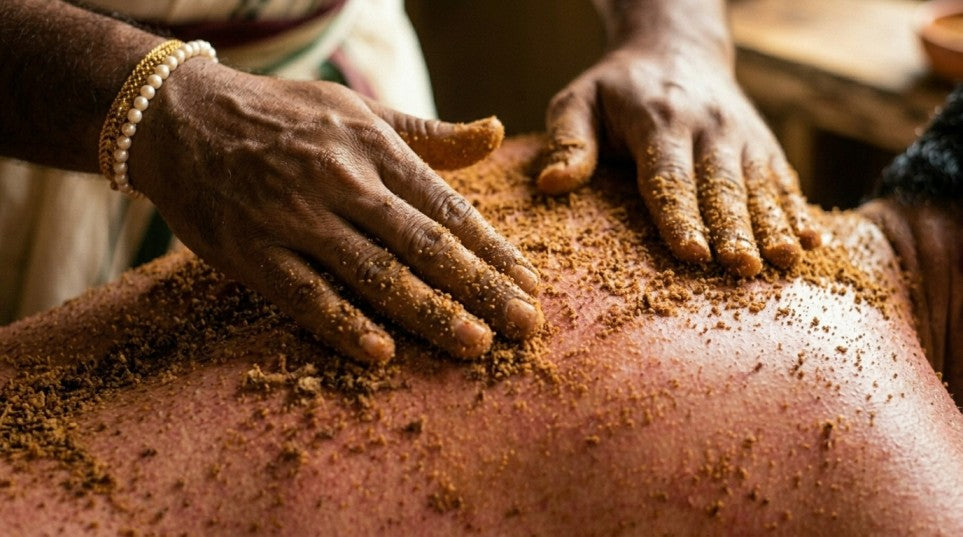
Kati (lower back/waist region) + basti (to hold or retain), a localised oil retention therapy in which a reservoir of warm medicated oil is held over the lumbar spine within a sealed dough dam. It is a site-specific Panchakarma therapy for any structural lumbar condition, and it addresses Vata aggravation in the lumbar channels through three mechanisms.
1. Warm oil reaches deeper than you'd expect
-
The warmth dilates local blood vessels and makes the tissues more permeable
-
Herbal compounds from the oil penetrate through the skin, through the muscle layers, and down to the disc and vertebrae
-
The disc has no direct blood supply, it gets its nutrition through slow diffusion from the bones above and below it
-
By improving blood flow in the surrounding tissues, Kati Basti improves this diffusion process, getting nourishment to disc tissue that would otherwise be very hard to reach
2. It breaks the spasm cycle
-
When a disc is injured, the surrounding muscles go into protective spasm and tighten to guard the damaged area
-
This is useful at first, but over time the spasm itself becomes a problem: it squeezes the disc further and cuts off blood flow to the tissues that need healing
-
The warm oil combined with the preparatory Abhyanga massage, directly relaxes this spasm, reducing pressure on the disc and letting circulation return
3. It nourishes the nerve tissue
-
The oils used in Kati Basti are chosen specifically for their ability to nourish nerve tissue (called Majja dhatu in Ayurveda)
-
Their active compounds reach the tissues surrounding the nerve through diffusion
-
This is why patients who complete a full course report more than just pain relief, they notice reduced tingling, improved sensitivity, and a back that feels structurally more supported
-
It is genuine nerve tissue restoration, not just temporary pain suppression
Which Lower Back Condition Is Most Responsive?
| Condition | Why Kati Basti Helps | Expected Outcome |
|---|---|---|
| Chronic lower back pain (non-specific) | Restores Vata lubrication; breaks paraspinal spasm; improves microcirculation | Significant pain reduction within 5–7 sessions; improved flexibility and morning stiffness |
| Lumbar spondylosis | Nourishes degenerated disc-adjacent tissues; reduces osteophyte-driven inflammation; slows progression | Pain relief and mobility improvement over 14-day course; slower disease progression with maintenance |
| Disc herniation (L4-L5, L5-S1) | Improves disc-adjacent microcirculation; reduces nerve root inflammation; nourishes Majja dhatu | Progressive pain and radiation reduction over 7–14 sessions; adjunct to Basti for nerve involvement |
| Sciatica | Reduces L5-S1 nerve root compression; Sahacharadi oil specifically for sciatic nerve pathway | Reduction in leg radiation typically begins by session 4–5; combined with Basti for nerve nourishment |
| Sacroiliac joint pain | Dam positioned to include sacral and SI region; direct oil penetration to SI joint | Improvement in SI pain and hip mobility within 5–7 sessions |
| Postural back pain (desk workers) | Resets paraspinal muscle tone; provides Vata-nourishing oil to chronically tense musculature | Rapid relief (2–3 sessions); most impactful with concurrent posture correction |
The Medicated Oils for Lower Back Pain
-
Mahanarayan Taila: The most widely used oil for musculoskeletal and disc conditions. Complex sesame-based formulation with Ashwagandha, Bala, Shatavari, and 25+ herbs. Anti-inflammatory, Vata-pacifying, and tissue-nourishing. Best for disc herniation with moderate degenerative involvement and most non-specific lower back pain presentations.
-
Ksheerabala Taila: For lower back pain with significant nerve involvement — radiating pain, numbness, or tingling in the leg. Deeply nourishing to Majja dhatu (nerve tissue), specifically indicated when sciatica or L4-L5/L5-S1 nerve root compression is present alongside the back pain.
-
Sahacharadi Taila: The specific indication for the sciatica component, pain radiating down the posterior thigh and leg from L5-S1 nerve root compression. Pronounced affinity for the sciatic nerve distribution.
-
Dhanwantharam Taila: For lower back pain with muscle weakness, post-surgical back conditions, or when the presentation follows injury or period of immobility. Specifically strengthening for musculature alongside its Vata-pacifying action.
-
Murivenna: For acute inflammatory presentations, localised heat, swelling, and severe pain in the acute phase. Anti-inflammatory and cooling; used when the tissue inflammation must be reduced before deeper nourishing oils can be introduced.
Kati Basti vs. Conventional Lower Back Treatments
| Approach | What It Addresses | Duration of Effect | Dependency Risk |
|---|---|---|---|
| NSAIDs / Painkillers | Pain signal suppression | Hours to days | High — dose escalation common |
| Steroid injection | Local inflammation reduction | Weeks to months | Limited courses available |
| Physiotherapy | Muscle strengthening and mobility | Sustained if maintained | Low — exercise-based |
| Kati Basti | Tissue nourishment, Vata restoration, spasm relief, disc support | Sustained post-course with maintenance | None — addresses root cause |
| Surgery (disc) | Structural decompression | Variable — 25-50% recurrence | N/A — invasive |
When Kati Basti Alone Is Not Enough
For disc herniation with nerve involvement, Kati Basti is most effective as part of a broader programme that includes internal Panchakarma Basti for systemic Vata restoration. The full Panchakarma programme includes Vasti sequences alongside Kati Basti for moderate to severe disc conditions with significant nerve involvement. Internal herbal formulations, primarily Yogaraj Guggulu and Ashwagandha, are prescribed alongside the Panchakarma programme to address systemic Vata and support tissue rebuilding.
For conditions where back pain is accompanied by knee pain or arthritis, a common pattern where altered gait from back pain shifts load to the knee, the programme addresses both conditions in the appropriate sequence.
Final Thoughts
Lower back pain that has been managed with painkillers for months or years without improvement is not an untreatable condition, it is a condition that has not been treated at its root.
The disc tissue drying out, the paraspinal muscles in chronic spasm, the nerve roots under persistent inflammatory pressure, these are all tissue-level changes that warm medicated oil, at the right temperature, in the right clinical context, directly addresses.
Frequently Asked Questions
Q. How many Kati Basti sessions for lower back pain?
A. For acute or mild lower back pain: 5–7 sessions typically produce significant improvement. For chronic conditions (spondylosis, disc herniation, longstanding back pain): 14 sessions is the standard course, often with a second course recommended after 4–6 weeks. For maintenance and prevention of recurrence: 5-session seasonal courses.
Q. Can I do Kati Basti at home?
A. No, not safely or effectively. The correct oil selection, dough dam construction, temperature maintenance throughout the session, and post-procedure care all require trained clinical administration. The large number of patients who report disappointing results from 'Kati Basti' typically received the wrong oil, at the wrong temperature, without adequate preparation, or in a DIY format. The procedure's effectiveness is almost entirely dependent on these factors being correct.
Q. Is Kati Basti safe for severe disc herniation?
A. Safe for most disc herniations including moderate to severe cases, when administered by a trained therapist. Contraindicated for: cauda equina syndrome (bladder and bowel dysfunction, a surgical emergency), progressive neurological deficit (foot drop worsening despite conservative management), active spinal infection or tumour, and recent spinal surgery within 6 weeks. Surgical consultation is appropriate for very large central herniations with significant cord compression.
Q. What is the cost of Kati Basti for lower back pain in Bangalore?
A. Session costs at Yuvrit depend on the oil formulation, whether the session includes the full preparatory Abhyanga and Swedana, and the course duration. Book a consultation for a transparent assessment of what your specific condition requires and the associated programme costs.
Related post
27
Apr
24
Apr

24
Apr
