 Free & discreet shipping on all prescriptions
 No insurance required


April 10, 2026
Panchakarma Treatment for Knee Pain
Ayurveda, the ancient system of natural healing, has been practiced for thousands of years in India. Its holistic approach to health focuses on balancing the mind, body, and spirit through natural remedies, diet, lifestyle adjustments, and therapies. In this post, we’ll explore the core principles of Ayurveda and how you can incorporate them into your daily routine for a healthier and more balanced life.
You have tried it all, the painkillers, the physiotherapy sessions, the hot and cold packs, perhaps even a steroid injection. The pain eases for a while, then quietly returns, often worse than before. If this sounds familiar, you are not alone. Millions of people across India live with recurring knee pain, cycling through treatments that manage symptoms but never truly address why the pain started in the first place.
Knee pain is rarely just a mechanical problem. In Ayurvedic understanding, it is a signal from the body that something deeper is out of balance, typically an aggravation of Vata dosha (governing movement and dryness in the body) or Kapha dosha (governing fluids and heaviness), or a build-up of Ama, the toxic residue that forms when digestion is impaired and metabolic waste accumulates in the joints.
This is why treating only the knee, without addressing the systemic imbalance driving the pain, tends to produce only temporary relief.
What Is Panchakarma?
Panchakarma literally means "five actions" in Sanskrit. It is Ayurveda's most comprehensive detoxification and rejuvenation system. It is not a single treatment but a structured sequence of therapies designed to draw accumulated toxins out of deep tissue, rebalance the three doshas, and restore the body's natural intelligence.
These are always preceded by preparatory therapies (Purvakarma) that involve oleation and steam, and followed by a structured recovery and dietary phase (Paschatkarma). This three-phase approach is what distinguishes Panchakarma from a simple massage or detox routine, it is a complete clinical protocol.
Importantly, a properly administered Panchakarma programme is always doctor-led and personalised. No two patients receive the same protocol.
How Panchakarma Specifically Addresses Knee Pain
Most conventional treatments focus on the knee joint in isolation, reducing swelling, blocking pain signals, or surgically repairing structural damage. Panchakarma works differently. It targets the underlying biological conditions that allow the pain to develop.
Ama Accumulation in the Joints
When digestive fire (Agni) is weakened, due to poor diet, stress, irregular eating, or age, food and metabolic processes produce incompletely processed waste called Ama. This sticky, toxic residue travels through the body's channels and deposits itself in vulnerable areas, frequently the joints. In the knee, Ama causes stiffness, inflammation, a feeling of heaviness, and over time, cartilage degradation. Panchakarma's detoxification therapies systematically flush this Ama from the tissues, clearing the channels so that healing nutrition can reach the joint.
Vata-Type vs. Kapha-Type Knee Pain
A skilled Ayurvedic doctor will first determine which dosha is primarily involved, because this shapes the entire treatment protocol:
-
Vata-type knee pain presents as dryness, cracking sounds in the joint, sharp or erratic pain, and stiffness that is worse in the morning or in cold weather. The joint may feel depleted and lacking in lubrication. Treatment focuses on oleation, warming therapies, and Basti.
- Kapha-type knee pain presents as swelling, puffiness, a dull aching sensation, heaviness, and pain that worsens with prolonged rest or in humid conditions. Treatment focuses on reducing accumulation through Swedana, Virechana, and dry massage techniques.
This individualisation is one of the key reasons Panchakarma produces durable results rather than temporary relief.
Reducing Synovial Inflammation Naturally
Chronic inflammation in the synovial membrane, the tissue lining the knee joint, is a major driver of persistent knee pain. Panchakarma therapies work through multiple anti-inflammatory pathways: medicated oils penetrate deep into the tissue through the skin, herbal formulations administered via Basti reach the joint through systemic circulation, and the reduction of Ama removes the primary trigger for immune-mediated inflammation. This is particularly relevant for those dealing with arthritis-related knee pain, where synovial inflammation is central to disease progression.
Key Panchakarma Therapies Used for Knee Pain
The specific therapies included in a knee pain protocol vary by patient, but these are the most commonly prescribed:
Abhyanga (Medicated Oil Massage)
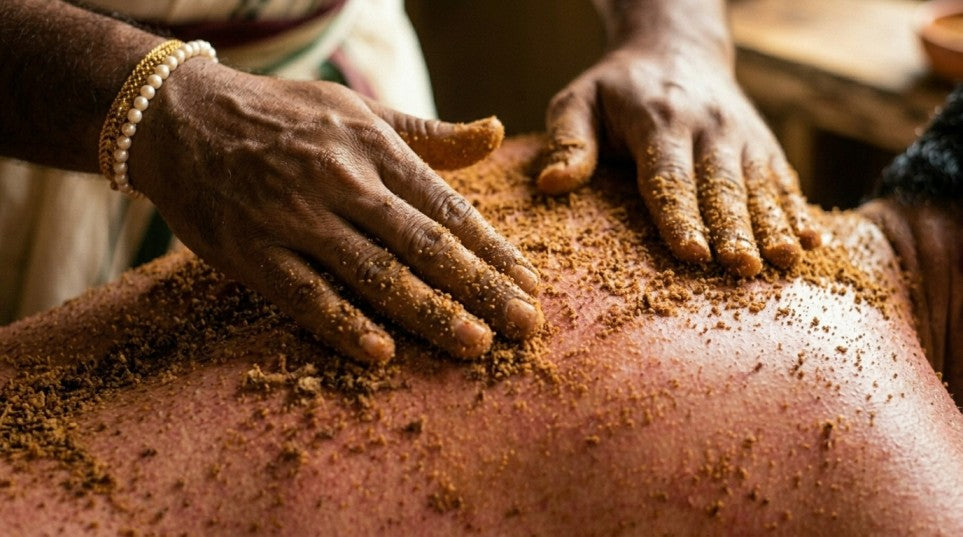
Abhyanga involves the application of warm, medicated oils, selected specifically for the patient's dosha and the nature of their knee condition, using rhythmic, pressure-based strokes. For the knee, this directly lubricates the joint, nourishes cartilage, reduces Vata aggravation, relaxes the surrounding musculature, and improves local circulation. It is often the foundation on which all other Panchakarma therapies are built.
For knee pain specifically, Ksheerabala Tailam and Sahacharadi Tailam are most commonly selected, based on whether Vata dryness or Kapha-driven inflammation is the primary imbalance.
Janu Basti (Localised Oil Pooling for the Knee)
Janu Basti is a highly targeted therapy in which a dam made of dough is placed around the knee joint and filled with warm medicated oil, which is held in place for 30–45 minutes. The sustained heat and medicated oil work together to deeply penetrate the joint capsule, nourish the cartilage, reduce bone-on-bone friction, and relieve the dryness and depletion characteristic of Vata-type knee pain. Patients with osteoarthritis, post-injury stiffness, or degenerative knee conditions often experience significant relief after a course of Janu Basti.
The most commonly used oils at Yuvrit for Janu Basti include Ksheerabala Tailam (for Vata-type degeneration and cartilage nourishment), Mahanarayana Tailam (for joint inflammation and stiffness), and Dhanvantaram Tailam (for post-injury and post-surgical knee recovery). Oil selection is determined after pulse diagnosis.
Swedana (Steam Therapy)
Medicated steam therapy opens the channels of the body (srotas), liquefies accumulated Ama, reduces joint stiffness, and prepares the tissues to absorb the oils used in Abhyanga and other treatments. For the knee specifically, Swedana relaxes the periarticular muscles, reduces morning stiffness, and increases the range of motion. It is frequently administered immediately after Abhyanga to enhance penetration of the medicated oils.
Vasti (Medicated Enema)
Vasti is considered the single most powerful Vata-pacifying treatment in all of Ayurveda, and since Vata governs all movement, including the deterioration and dryness in joints, it plays a central role in most knee pain protocols. Medicated oils and herbal decoctions administered via Vasti are absorbed through the intestinal mucosa and enter systemic circulation, reaching the joints and nourishing them from within. Vasti also cleanses the colon, which in Ayurvedic understanding is the primary seat of Vata, making it the deepest and most systemic tool available for joint health.
Virechana (Therapeutic Purgation)
For Kapha or Pitta-dominant knee conditions, particularly those involving swelling, heat, and inflammation, Virechana is often included in the protocol. This controlled purgation treatment eliminates Pitta-dominant toxins from the liver and intestines, reducing systemic inflammation and the excess heat that drives inflammatory joint conditions.
Ayurvedic Herbs Used Alongside Panchakarma for Knee Pain
Alongside external therapies, your treating doctor will prescribe internal herbal formulations to reduce inflammation, rebuild cartilage, and correct the systemic dosha imbalance. The most commonly prescribed herbs include:
-
Guggulu (Commiphora mukul): The most important anti-inflammatory herb in Ayurveda for joint conditions. Prescribed as Yogaraja Guggulu or Mahayogaraja Guggulu, it reduces synovial inflammation, inhibits cartilage breakdown, and improves joint mobility over a sustained course.
-
Shallaki / Boswellia Serrata: Clinically studied for osteoarthritis. Reduces joint swelling, morning stiffness, and improves range of motion. It works by inhibiting inflammatory leukotrienes without the gastric side effects associated with long-term NSAID use.
-
Ashwagandha (Withania somnifera): Reduces systemic inflammation, strengthens periarticular muscles around the knee, and supports cartilage integrity. Particularly useful when Vata-type knee pain is accompanied by fatigue and generalised muscle weakness.
-
Shatavari (Asparagus racemosus): A Rasayana herb that nourishes the Dhatus (body tissues) and supports joint lubrication. Especially useful in post-menopausal or hormonal-related joint degeneration.
-
Rasna (Pluchea indica): A classical Vata-pacifying herb prescribed specifically for musculoskeletal pain, joint stiffness, and nerve-related knee discomfort.
The specific formulation and dosage are always determined by your treating doctor after pulse diagnosis.
Dietary Support During Panchakarma for Knee Pain
Since Vata aggravation drives most degenerative knee conditions, a Vata-pacifying diet is recommended throughout and after treatment.
-
Favour: Warm, cooked, oily foods like khichdi, soups, ghee, sesame seeds, warm turmeric milk, cooked root vegetables, wheat and oats.
-
Avoid: Cold, raw, dry, and processed foods like raw salads, refrigerated foods, carbonated drinks, excess caffeine, and irregular meal timing.
Daily Haldi doodh (turmeric milk with black pepper) provides natural anti-inflammatory support between therapy sessions.
How Long Does Panchakarma Take for Knee Pain?
A standard Panchakarma course for knee pain consists of 14–21 consecutive days of daily treatment, depending on the severity of the condition, the patient's age, digestive strength, and whether structural degeneration is present.
A typical daily schedule includes Abhyanga (30–40 minutes), Swedana steam therapy (15–20 minutes), Janu Basti (30–45 minutes), and Vasti or Virechana on prescribed days.
Most patients report a noticeable reduction in stiffness and pain by Day 7–10. Measurable improvement in range of motion and walking distance typically becomes evident by Day 14–18.
After completion, a post-Panchakarma protocol is prescribed for 30–45 days, including dietary guidelines, herbal formulations, and at-home oil application, to consolidate the outcomes.
Conditions That Panchakarma Helps: Beyond Basic Knee Pain
Panchakarma treatment for knee pain is effective across a wide range of underlying conditions. Understanding which condition is driving your knee pain is essential for accurate treatment planning.
-
Osteoarthritis (Sandhivata): The most common cause of knee pain in adults over 40 is Osteoarthritis. Characterised by cartilage degeneration and bone-on-bone friction, it maps closely to Vata-type imbalance in Ayurveda. Janu Basti and Basti are the cornerstones of treatment.
-
Rheumatoid Arthritis (Amavata): Rheumatoid Arthritis An autoimmune condition causing inflammatory joint destruction. In Ayurveda, it is understood as Ama combined with Vata, lodging in the joints. Panchakarma's detoxification focus makes it highly appropriate, though management requires ongoing care.
-
Post-injury stiffness and sports injuries: Ligament strains, meniscus injuries, and post-surgical stiffness all respond well to Abhyanga and Swedana in combination, accelerating tissue repair and restoring range of motion.
-
Co-occurring lower back pain: Knee pain and lower back pain frequently occur together, altered gait due to knee pain shifts load onto the lumbar spine, and vice versa. Panchakarma addresses both simultaneously, making it ideal for patients dealing with multiple pain sites.
-
Referred pain from sciatica: Pain that radiates down the leg from a compressed sciatic nerve is frequently misidentified as knee pain. If your knee pain is accompanied by radiating sensations, tingling, or numbness, it is worth ruling out a nerve component.
Panchakarma vs. Conventional Knee Pain Treatments
Understanding how Panchakarma compares to and complements conventional approaches helps patients make informed decisions about their own care.
-
Painkillers (NSAIDs): Effective for short-term pain management but do not halt joint degeneration and carry significant risks with long-term use (gastric damage, cardiovascular effects, kidney strain). Panchakarma addresses the underlying inflammation rather than suppressing the pain signal alone.
-
Steroid injections: Provide powerful but temporary relief. Repeated use can actually accelerate cartilage breakdown. Panchakarma's approach is designed to nourish and protect cartilage rather than chemically suppress inflammation.
-
Physiotherapy: Excellent for strengthening the muscles around the knee and improving biomechanics. Panchakarma and physiotherapy work very well together, Panchakarma reduces inflammation and stiffness that may otherwise limit physiotherapy progress.
- Knee replacement surgery: Appropriate for severe, end-stage joint destruction. Panchakarma is most valuable as a first-line intervention that may slow degeneration significantly and delay or avoid the need for surgery, particularly in patients who are in the early to moderate stages of osteoarthritis.
Panchakarma can be done pre and post surgery to strengthen the knee joint and surrounding tissues which will help in faster recovery from surgery
Frequently Asked Questions
Q. How many sessions of Panchakarma are needed for knee pain?
A. It depends on the severity and chronicity of your condition. Mild to moderate knee pain may respond well to a 7–14 day programme. Long-standing osteoarthritis or rheumatoid arthritis typically requires 21 days of intensive therapy, followed by periodic maintenance programmes. Your doctor will assess this during the initial consultation.
Q. Is Panchakarma safe for osteoarthritis patients?
A. Yes, when administered by qualified Ayurvedic doctors, Panchakarma is safe and highly appropriate for osteoarthritis. In fact, it is one of the few treatment systems that actively works to nourish and protect remaining cartilage rather than simply masking pain. It is particularly effective in the early to moderate stages of the disease.
Q. Can Panchakarma be done alongside physiotherapy?
A. Absolutely. Physiotherapy and Panchakarma are complementary approaches, one works on biomechanics and muscle strength, the other addresses internal inflammation and tissue health. Many patients at Yuvrit continue physiotherapy alongside or after their Panchakarma programme and report that the reduced pain and stiffness from Panchakarma allows them to engage more effectively in physiotherapy exercises.
Q. How do I know if Panchakarma is right for my body type?
A. Understanding your dosha constitution is a helpful starting point. While a doctor's consultation is the definitive way to determine the right treatment, you can begin with Yuvrit's body type quiz to understand your Prakriti and how it influences your health tendencies.
Related post
27
Apr
24
Apr
24
Apr
