 Free & discreet shipping on all prescriptions
 No insurance required


March 19, 2026
Ayurvedic Treatment for Sciatica: A Complete Guide
Ayurveda, the ancient system of natural healing, has been practiced for thousands of years in India. Its holistic approach to health focuses on balancing the mind, body, and spirit through natural remedies, diet, lifestyle adjustments, and therapies. In this post, we’ll explore the core principles of Ayurveda and how you can incorporate them into your daily routine for a healthier and more balanced life.
Sciatica is one of the most distressing forms of lower back pain. Unlike general back discomfort, sciatica involves sharp, radiating pain that travels from the lower back down through the buttock and into the leg. For many individuals, the pain is burning, tingling, electric, or shooting in nature. Sitting becomes uncomfortable. Walking long distances becomes difficult. Even simple movements like bending forward may trigger intense discomfort.
In many cases, patients are advised painkillers, muscle relaxants, physiotherapy, steroid injections, or even surgery. While these options may offer temporary relief, recurrence is common if the underlying cause is not corrected.
Ayurvedic treatment for sciatica approaches the condition differently. In classical Ayurvedic texts, sciatica correlates with a disorder called Gridhrasi, a Vata-dominant condition affecting the lower back and sciatic nerve pathway. Rather than treating only nerve irritation, Ayurveda aims to pacify aggravated Vata, restore lubrication to spinal tissues, reduce inflammation, and strengthen structural support around the spine.
Understanding Sciatica from a Modern Medical Perspective
The sciatic nerve is the largest nerve in the body. It originates in the lower lumbar spine (L4-S3 nerve roots) and travels through the buttocks down into each leg. When this nerve becomes irritated or compressed, symptoms radiate along its pathway.
Common causes include disc bulge, herniated disc, spinal stenosis, degenerative disc disease, or muscular compression such as piriformis syndrome. When intervertebral discs lose height or protrude outward, they may press on adjacent nerve roots, triggering inflammation and pain.
Symptoms often begin in the lower back and gradually radiate down the back of the thigh. Some individuals experience numbness, tingling, or muscle weakness in the affected leg. In severe cases, walking tolerance reduces significantly.
Sciatica is not a disease in itself. It is a symptom of underlying nerve irritation.
Ayurveda expands this understanding by explaining why certain individuals develop recurrent nerve pain while others recover quickly.
Stages of Sciatica Progression
Sciatica typically progresses through identifiable stages. Early intervention at milder stages significantly improves recovery outcomes.
Stage 1: Localized Lower Back Pain
In the initial stage, pain may remain confined to the lower back. The discomfort may be dull or intermittent. Stiffness after prolonged sitting is common. At this stage, nerve irritation may be minimal.
From an Ayurvedic perspective, this reflects early Vata aggravation localized in the lumbar region. Lubrication begins to reduce, and muscular tightness develops.
Stage 2 : Radiating Pain to the Thigh
As nerve irritation increases, pain may begin radiating into the buttock and upper thigh. Sitting for long periods may worsen symptoms.
This stage indicates deeper Vata disturbance affecting nerve channels (Majja Dhatu involvement).
Stage 3 : Tingling and Numbness
At this stage, neurological symptoms become more noticeable. Patients may report tingling, burning sensations, or numbness extending below the knee.
Ayurvedically, this suggests stronger Vata obstruction combined with possible Kapha stagnation blocking nerve pathways.
Stage 4 : Weakness and Severe Compression
In advanced cases, muscle weakness may develop. Walking becomes difficult. Pain may persist even at rest.
This reflects chronic Vata dominance with structural depletion of Asthi Dhatu (bone tissue) and Majja Dhatu.
Early treatment prevents progression to severe nerve compromise.
Sciatica vs Slip Disc vs Spondylosis
| Feature | Sciatica | Slip Disc | Lumbar Spondylosis |
|---|---|---|---|
| Pain Type | Local + radiating | Local + radiating | Mostly localized |
| Cause | Nerve irritation | Disc herniation | Degeneration |
| Numbness | Common | Possible | Rare |
| Onset | Gradual/acute | Often sudden | Gradual |
Sciatica in Ayurveda (Gridhrasi)
In Ayurvedic literature, sciatica is described as Gridhrasi, named after the vulture-like gait adopted by sufferers due to pain. It is primarily classified as a Vata disorder, though Kapha involvement may also be present.
Vata governs movement, nerve conduction, and pain perception. When Vata becomes aggravated due to excessive dryness, overexertion, aging, stress, or improper diet, it localizes in vulnerable areas such as the lumbar spine.
Asthi Dhatu (bone tissue) and Majja Dhatu (nerve tissue) play crucial roles in spinal stability. When digestive strength weakens, tissue nourishment declines. Over time, structural degeneration may predispose to nerve compression.
In some cases, Ama accumulation contributes to inflammation around the nerve roots. This creates additional obstruction in nerve pathways.
Thus, sciatica is understood as a combination of:
-
Vata aggravation
-
Structural depletion
-
Possible Kapha stagnation
-
Ama obstruction
Treatment must address all contributing factors.
Root Causes of Sciatica According to Ayurveda
In Ayurveda, sciatica (Gridhrasi) is not viewed as a random nerve problem. It develops gradually due to accumulated imbalance, primarily involving aggravated Vata dosha. Vata governs movement, nerve impulses, and pain perception.
One of the most significant contributors is prolonged sitting. Modern work culture places sustained pressure on the lumbar spine. Over time, this compresses intervertebral discs and weakens spinal support structures. From an Ayurvedic perspective, prolonged static posture aggravates Vata and reduces lubrication in the spinal joints.
Improper diet also plays a major role. Dry, cold, processed, and irregular meals weaken digestive fire (Agni). When digestion becomes inefficient, Ama (metabolic toxins) accumulates. This Ama may lodge in spinal channels (Srotas), contributing to inflammation around nerve roots.
Common contributing factors include:
-
Long hours of sitting or driving
-
Sudden heavy lifting
-
Improper bending technique
-
Chronic constipation
-
Inadequate hydration
-
Emotional stress
-
Aging-related tissue depletion
Chronic stress deserves special mention. Persistent stress increases muscle tension in the lower back and hips. Tight musculature around the piriformis muscle may compress the sciatic nerve, aggravating symptoms.
With advancing age, natural tissue dryness increases. If nourishment to Asthi Dhatu (bone tissue) and Majja Dhatu (nerve tissue) declines due to weak digestion, degeneration may accelerate.
Thus, sciatica develops from a combination of mechanical strain and systemic imbalance.
Symptoms of Sciatica
Unlike simple muscular back pain, sciatica follows the pathway of the sciatic nerve. This nerve runs from the lumbar spine through the buttock and into the back of the thigh, sometimes extending to the calf or foot. The location of symptoms often indicates which nerve root is involved.
Many patients initially experience mild lower back discomfort. As nerve irritation increases, radiating leg pain becomes more noticeable. Sitting often aggravates symptoms because it increases disc pressure.
In more advanced cases, neurological symptoms may appear:
-
Tingling or numbness in the leg
-
Weakness in foot or ankle
-
Difficulty standing for long periods
-
Heaviness in the affected leg
Some individuals describe difficulty straightening the leg fully due to pain. In severe cases, walking becomes limited.
From an Ayurvedic perspective, tingling and numbness indicate deeper involvement of Majja Dhatu (nerve tissue) along with aggravated Vata. Burning sensation may suggest secondary Pitta involvement, while heaviness may indicate Kapha stagnation.
Early recognition prevents progression to severe nerve compression.
Diagnosis of Sciatica in Ayurveda
Evaluation begins with Nadi Pariksha (pulse diagnosis). This helps determine the extent of Vata aggravation and whether Ama or inflammatory components are present. Pulse examination also provides insight into digestive strength, which influences tissue nourishment.
Physical examination includes assessment of posture, spinal curvature, and muscular tightness. The straight leg raise test may reproduce radiating pain, confirming sciatic nerve involvement. Areas of tenderness and restricted movement are carefully evaluated.
If available, MRI or X-ray reports are reviewed to assess:
-
Disc bulge or herniation
-
Nerve root compression
-
Degenerative changes
-
Spinal canal narrowing
However, Ayurveda recognizes that structural changes in imaging do not always correlate with pain severity. Some individuals with mild disc bulges experience severe pain due to Vata aggravation, while others with visible degeneration remain relatively asymptomatic.
Ayurvedic Treatment for Sciatica
Treatment aims to pacify Vata, reduce nerve inflammation, improve spinal lubrication, and strengthen structural support.
-
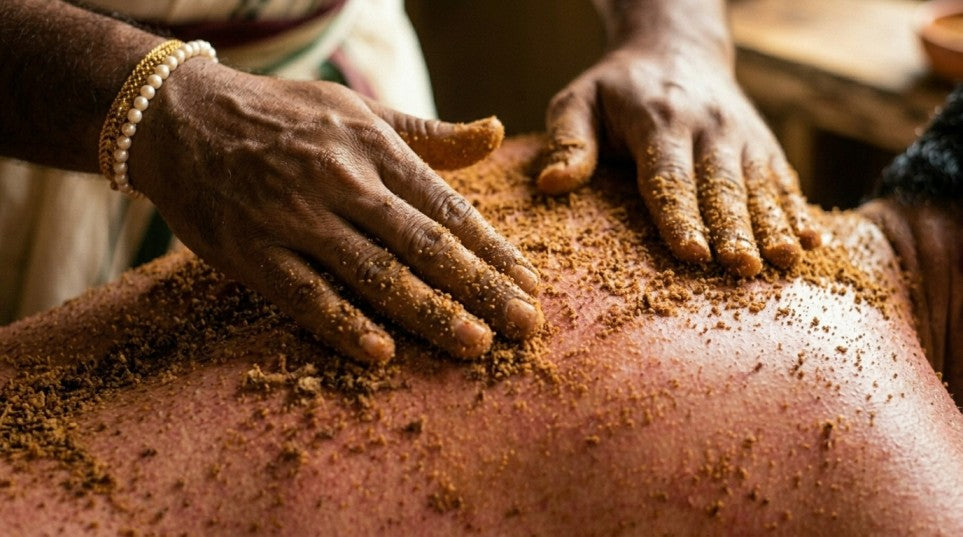
Kati Basti (Primary Therapy) : Kati Basti involves retaining warm medicated oil over the lower back region. This deeply nourishes spinal tissues and reduces stiffness. It improves circulation and relieves nerve pressure indirectly by relaxing surrounding muscles. Kati Basti is often the cornerstone of sciatica management.
-
Panchakarma: In moderate to chronic sciatica, Panchakarma may be recommended. Basti therapy, in particular, is highly effective for Vata disorders. Medicated enemas help pacify systemic Vata and reduce nerve irritation.
-
Abhyanga: Full-body oil massage reduces muscular tension and calms aggravated Vata. Abhyanga supports circulation and relaxation.
-
Elakizhi : involves application of heated herbal boluses to reduce stiffness and improve muscle flexibility. Therapy selection depends on stage and severity.
Internal Herbal Support
Internal herbal therapy supports nerve healing, reduces inflammation, and strengthens musculoskeletal tissues. In sciatica, herbs are selected based on whether pain is primarily degenerative, inflammatory, or muscular.
Herbal support often includes:
-
Dashamoola: Reduces Vata-driven pain and inflammation
-
Shallaki: Supports joint comfort and reduces inflammatory response
-
Yogaraj Guggulu: Traditionally used in Vata disorders affecting joints
-
Rasna: Helpful in musculoskeletal stiffness
-
Ashwagandha: Supports nerve strength and reduces stress
Dashamoola is particularly valuable in acute Vata pain. Shallaki may help reduce inflammatory components around nerve roots. Ashwagandha supports nerve tissue resilience and stress regulation.
Herbal prescriptions are personalized based on stage, constitution, and digestive capacity. Long-term support may be required in chronic cases.
Herbs complement external therapies and enhance overall recovery.
Role of Diet in Sciatica
Diet plays an important supportive role in sciatica management. Since Vata aggravation is central to the condition, dietary habits that increase dryness and irregularity must be corrected.
Cold, dry, processed foods aggravate Vata and reduce tissue lubrication. Skipping meals or eating at irregular times weakens digestion and impairs tissue nourishment.
Warm, freshly prepared meals support digestive fire and enhance nutrient absorption. Moderate use of ghee improves lubrication of tissues, counteracting Vata dryness.
Hydration is also essential. Dehydration may contribute to disc dehydration over time.
Dietary support generally includes:
-
Warm, cooked meals
-
Light but nourishing foods
-
Adequate hydration
-
Avoidance of dry snacks
Digestive strength directly influences Asthi and Majja Dhatu nourishment. Therefore, maintaining consistent meal timing enhances recovery.
Lifestyle & Posture Correction
Lifestyle correction prevents recurrence. Ergonomic sitting posture reduces lumbar strain. Sudden forward bending should be avoided during acute episodes.
Core strengthening under supervision improves spinal stability. Adequate sleep supports nerve healing.
Stress management reduces muscle tension and consistency is key to preventing relapse.
Can Sciatica Be Permanently Cured in Ayurveda?
Acute sciatica often responds well to early intervention. When nerve compression is mild, complete recovery is possible.
Chronic cases may require longer treatment duration. While structural disc changes may not fully reverse, pain and functional limitations can significantly improve.
Consistent therapy, diet, and lifestyle alignment reduce recurrence risk. Ayurveda focuses on restoring stability rather than masking symptoms.
Related post
27
Apr
24
Apr

24
Apr
