 Free & discreet shipping on all prescriptions
 No insurance required


April 21, 2026
Panchakarma Treatment for Sciatica
Ayurveda, the ancient system of natural healing, has been practiced for thousands of years in India. Its holistic approach to health focuses on balancing the mind, body, and spirit through natural remedies, diet, lifestyle adjustments, and therapies. In this post, we’ll explore the core principles of Ayurveda and how you can incorporate them into your daily routine for a healthier and more balanced life.
Sciatica is the sharp, burning, or shooting pain that travels from your lower back down through your buttock and into your leg. For some people it is a dull constant ache. For others it feels like an electric shock every time they move. It can make sitting, walking, bending, and even sleeping difficult.
The pain comes from your sciatic nerve, the longest nerve in the body. When it gets compressed or irritated, it sends pain signals all the way down the leg. The compression is usually caused by a slipped disc, a tight piriformis muscle, or narrowing of the spinal canal.
Most people try painkillers or physiotherapy. These help for a while. But the pain keeps returning, sometimes worse than before. That is because painkillers and most physical therapy only address the pain signal. They do not address why the nerve is being compressed in the first place, or why the surrounding tissues are too dry, too stiff, and too inflamed to recover properly.
Ayurveda’s approach to sciatica begins with this question: what is the root cause? Panchakarma treatment goes much deeper than symptom relief.
How Ayurveda Understands Sciatica
Ayurveda describes sciatica as Gridhrasi, a word derived from Gridhra, meaning eagle. The name comes from the characteristic way a person with sciatica walks: stiffly, favouring one leg, much like an eagle's gait. It is a Vata disorder, which in plain terms means a disorder caused by dryness, stiffness, and disrupted nerve function.
What is Vata?
Think of Vata as the element that governs movement in the body - nerve signals, blood flow, joint mobility, and the rhythm of all bodily functions. When Vata becomes aggravated, it creates dryness and instability. Joints lose their natural lubrication, nerves become hypersensitive, muscles go into spasm. The discs between the vertebrae lose moisture and start to bulge or herniate. All of these changes can compress the sciatic nerve and produce the shooting pain down the leg.
In some people, Kapha also gets involved. This adds heaviness, swelling, and a dull, chronic quality to the pain. A Vata-Kapha sciatica tends to be worse in cold, damp weather and in the morning after sleep.
Why does Ayurveda focus on Vata?
The lower back and colon are considered the primary seat of Vata in the body. When the colon is not functioning well, when diet is irregular, when stress is high, or when someone sits for long hours without movement, Vata accumulates in the lower back region and begins to affect the sciatic nerve pathway.
This is why Ayurvedic treatment for sciatica focuses heavily on the colon (through Vasti), the lumbar region (through Kati Basti), and the whole nervous system (through Abhyanga and herbal medicines).
Why Panchakarma and Not Just Massage?
Many clinics offer a single oil massage or a few sessions of Kati Basti for sciatica and call it Panchakarma. Real Panchakarma is a multi-step programme that prepares the body, performs specific detox procedures, and then rebuilds the tissues. Here is why the full programme produces better and longer-lasting results for sciatica:
-
It clears the root cause: not just the symptom. By clearing accumulated toxins (Ama) from the lumbar channels and restoring the colon's function, Panchakarma removes the conditions that are keeping the nerve compressed and inflamed.
-
It nourishes the dry tissue: not just relaxes the muscles. The medicated oils used in Panchakarma procedures penetrate deeply into the nerve and disc tissue, re-hydrating structures that have become brittle and prone to injury.
-
It resets the nervous system: Vata, once aggravated, keeps the nervous system in a hypersensitive state. Panchakarma's oil-based procedures calm this hypersensitivity, reducing both the frequency and intensity of sciatic flare-ups.
The Panchakarma Procedures Used for Sciatica
1. Vasti - Medicated Enema Therapy
Vasti is considered the most important Panchakarma treatment for any Vata disorder, and therefore the most important for sciatica. It works through the colon, which is the seat of Vata in the body. Medicated oils and herbal decoctions are administered through the rectum and retained briefly before evacuation. This directly calms aggravated Vata, lubricates the colon, and restores the nerve pathways.
Two types of Vasti are used for sciatica. Anuvasana Vasti uses warm medicated oil and is nourishing, it soothes the dried, hypersensitive nerve channels. Kashaya Vasti uses an herbal decoction and is purifying, it clears accumulated Ama from the colon and lumbar region. These two are alternated in a structured sequence called Karma Vasti for best results.
Most sciatica patients report a noticeable reduction in the leg pain and tingling within the first three to four Basti sessions.
2. Kati Basti - Warm Oil Retention Over the Lower Back
In Kati Basti, a ring of flour dough is placed on the lower back and filled with warm medicated oil. The oil sits in contact with the lumbar spine for 30 to 45 minutes at a carefully maintained temperature. This treatment directly nourishes the disc, ligament, and nerve root tissue in the lumbar region, the exact area from which sciatica originates.
The warm oil opens the blood vessels in the area, improving circulation to tissues that are usually poorly supplied. The herbal actives in the oil then reach the disc and nerve structures through this improved circulation, helping to reduce the inflammation and dryness that is compressing the sciatic nerve.
3. Abhyanga - Full Body Medicated Oil Massage
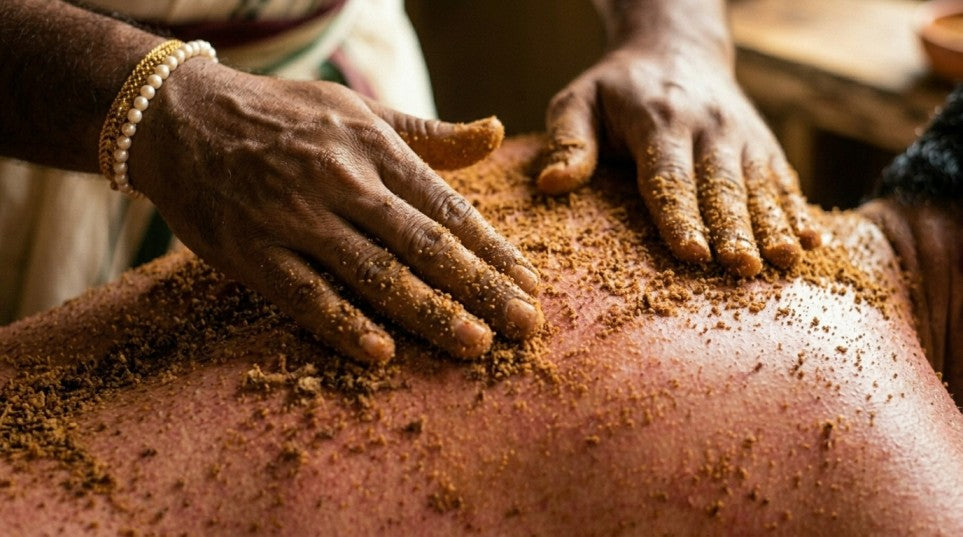
A proper Abhyanga is not a relaxation massage. It is a therapeutic procedure using warm medicated oils selected specifically for Vata conditions. For sciatica, oils like Mahanarayan Taila or Dhanwantharam Taila are typically used. The sustained pressure and warmth of the massage calms the nervous system, loosens the tight muscles along the sciatic pathway (particularly the piriformis and gluteal muscles), and prepares the body for deeper procedures like Basti and Kati Basti.
Abhyanga is performed before Kati Basti in every session, making the Kati Basti significantly more effective than when administered without this preparation.
4. Potli Therapy - Herbal Bolus Therapy
In Potli Therapy, warm herbal leaves are bundled into boluses and used to massage and apply heat to the lower back, buttock, and leg. This combines heat therapy with herbal anti-inflammatory action in a single step. It is particularly useful when there is significant muscle spasm and swelling alongside the nerve pain.
5. Virechana - Therapeutic Purgation
When sciatica is accompanied by significant inflammation, Pitta-type heat in the back, or when the patient has digestive issues that are contributing to Ama accumulation in the lumbar region, Virechana (controlled therapeutic purgation) may be included in the programme.
Virechana clears the liver and intestinal channels of Pitta-Ama, reducing the systemic inflammatory load that is keeping the sciatic nerve hypersensitive.
The Herbal Medicines That Support Recovery
Internal herbal medicines are prescribed alongside Panchakarma procedures to address the Vata-driven sciatica pattern from the inside:
-
Yogaraj Guggulu: the primary formulation for Vata-type joint and nerve conditions. Reduces inflammation, relieves muscle spasm, and supports connective tissue health around the sciatic nerve.
-
Ashwagandha: strengthens and nourishes nerve tissue, reduces cortisol (which drives inflammation), and helps the body recover from the stress that often triggers sciatic flares.
-
Sahacharadi Kashaya: a decoction specifically indicated for sciatic nerve pain and lower limb weakness. Taken twice daily, it reduces nerve irritation and supports recovery of the leg strength that sciatica often impairs.
-
Rasnasaptakam Kashaya: a classical Vata-reducing decoction with specific affinity for the lower back and sciatic pathway. One of the most commonly prescribed formulations for Gridhrasi (sciatica) in classical Ayurveda.
Diet and Lifestyle for Sciatica Recovery
What you eat and how you move between sessions matters as much as the treatment itself. These are the most impactful ayurvedic diet changes for sciatica recovery:
Food
-
Eat warm, freshly cooked meals: cold and raw food aggravates Vata and delays recovery.
-
Include ghee in your cooking: it is the primary food for nourishing nerve and joint tissue in Ayurveda.
-
Avoid cold beverages: drink warm water throughout the day instead.
-
Add ginger, turmeric, and black pepper to your food: these reduce nerve inflammation naturally.
-
Avoid excessive caffeine: it dries the nerve channels and aggravates Vata.
Movement
-
Avoid sitting for more than 45 minutes at a stretch. Stand up, walk around for 5 minutes, and sit back down.
-
Gentle yoga: Bhujangasana (Cobra), Setu Bandha (Bridge), and Supta Matsyendrasana (Supine twist) support sciatic nerve recovery. Avoid deep forward bends and heavy leg exercises during the acute phase.
-
Sleep on a firm mattress: a soft surface allows the lumbar spine to sink into flexion overnight, aggravating disc pressure on the sciatic nerve.
Related Conditions That Often Come with Sciatica
Sciatica rarely comes alone. These conditions frequently co-exist and are addressed as part of the Yuvrit programme:
-
Lower back pain: the origin of most sciatica. Addressed through Kati Basti and Basti.
-
Lumbar spondylosis: degenerative changes in the lower spine that narrow the canal and compress the sciatic nerve. Kati Basti and internal medicines slow this progression significantly.
-
Knee pain: altered walking patterns from sciatica shift load to the knees. Both conditions are assessed and treated in the same programme when needed.
Final Thoughts
Sciatica does not have to be a recurring part of your life. When the nerve is nourished rather than just numbed, when the disc tissue is rehydrated rather than just rested, and when the Vata disturbance driving the nerve compression is genuinely corrected, the recovery is real and it lasts.
Frequently Asked Questions
Q. Can Panchakarma treat severe sciatica without surgery?
A. For most disc-related sciatica cases, including moderate disc herniations at L4-L5 and L5-S1 — a well-designed Panchakarma programme produces significant improvement without surgery. The exceptions are cauda equina syndrome (bladder and bowel dysfunction — a surgical emergency) and progressive neurological deficit that is worsening despite treatment. Surgery is appropriate and necessary in these cases. Yuvrit's doctors will assess your case honestly and refer for surgical consultation when that is the right recommendation.
Q. How many sessions are needed?
A. This depends on the severity and duration of your sciatica. A recent, mild first episode may respond in 7–10 sessions. Chronic, longstanding sciatica typically requires 14–21 sessions with a second maintenance course 6 months later.
Q. Is Panchakarma for sciatica painful?
A. No. Basti, Kati Basti, and Abhyanga are all non-invasive, non-painful procedures. Kati Basti is typically described as deeply relieving, the warm oil on the lower back produces immediate comfort. Basti is similar to a warm enema and is not painful when properly administered.
Q. Can I do Panchakarma for sciatica if I have already had back surgery?
A. Yes, in many cases. Post-surgical sciatica, where the nerve pain persists or recurs after surgery responds well to Panchakarma because the surgery addressed the structural compression but did not address the underlying Vata dryness and nerve tissue depletion that made the disc vulnerable in the first place. Your Yuvrit doctor will assess your surgical history and design the programme accordingly.
Related post
27
Apr
24
Apr

24
Apr
