 Free & discreet shipping on all prescriptions
 No insurance required


April 23, 2026
Panchakarma Treatment for Cervical Spondylosis
Ayurveda, the ancient system of natural healing, has been practiced for thousands of years in India. Its holistic approach to health focuses on balancing the mind, body, and spirit through natural remedies, diet, lifestyle adjustments, and therapies. In this post, we’ll explore the core principles of Ayurveda and how you can incorporate them into your daily routine for a healthier and more balanced life.
Cervical spondylosis is the gradual wear and tear of the discs and joints in the neck. As the discs between the neck vertebrae dry out and thin, the joints develop bone spurs, and the muscles tighten to compensate. This produces the characteristic pain, stiffness, and — when nerve roots are compressed, the tingling and numbness that travel from the neck down into the shoulder, arm, and hand.
Most people are given painkillers, a neck collar, and physiotherapy.These may provide temporary relief, but the stiffness often returns, the tingling comes back, and the collar can feel uncomfortable without addressing the root cause. Over time, the painkillers may also become less effective at the same dose.
The reason these approaches often fail to provide lasting relief is simple: cervical spondylosis is a degenerative condition. The discs gradually lose hydration, the joints begin to wear down, and the surrounding muscles can become chronically tight and poorly nourished. Painkillers may reduce the sensation of pain, but they do not restore disc health or improve circulation to the affected tissues. Physiotherapy can help strengthen the muscles and improve mobility, but it may not fully address the underlying degeneration, inflammation, or tissue dryness contributing to the condition
Ayurveda’s approach to cervical spondylosis begins with this question: what is causing the tissue to deteriorate, and can that be reversed? Panchakarma is the system that attempts to do this.
How Ayurveda Understands Cervical Spondylosis
Classical Ayurvedic texts describe the condition using two terms. Manyastambha refers to stiffness and restricted movement of the neck whileVishvachi describes the pain and tingling that radiates into the arm, what modern medicine refers to as cervical radiculopathy. Both are classified in Ayurveda as Vata-Kapha conditions.
What Vata and Kapha mean in simple terms
Think of Vata as the energy that governs dryness, movement, and nerve function. When it is aggravated in the cervical region, the discs lose moisture. The joints become stiff and creak. The nerve roots become hypersensitive, producing the burning, electric-shock quality of cervical arm pain. Vata aggravation is the root of the degenerative, drying process.
Kapha governs structure and accumulation. In later-stage cervical spondylosis, Kapha produces the heaviness, the bone spur formation, and the progressive structural narrowing of the cervical canal. It adds weight and resistance to the already compromised joints.
The combination produces the full picture of cervical spondylosis: dry, thinning discs (Vata) with bone spur formation (Kapha), chronically tight muscles, reduced range of motion, and compressed nerve roots.
Why desk work and phone use make it worse
When you look at a screen, your head naturally tips forward. For every inch the head moves forward from its natural balance point over the spine, the effective weight it places on the cervical spine increases significantly. The neck muscles work constantly to hold this forward position. Over months and years, this sustained muscular tension creates poor circulation in the cervical region, which starves the discs of the nutrition they need to stay hydrated. The disc degeneration that follows is what cervical spondylosis represents.
Why Panchakarma
Many clinics offer a neck massage and call it Panchakarma for cervical spondylosis. Genuine Panchakarma for this condition is a multi-step programme with a specific sequence of procedures. Each step builds on the previous one. Here is why it works better than massage alone:
-
Snehana (oleation) returns the lubrication that Vata has depleted from the disc and joint tissue. The oil penetrates to the tissue level, not just the skin.
-
Swedana (heat therapy) dilates blood vessels in the neck and shoulder region, improving circulation to the avascular disc tissue. It also softens the structural stiffness that Kapha has created.
-
Greeva Basti delivers concentrated, sustained oil contact directly to the cervical spine, the most targeted procedure available for this condition.
-
Nasya reaches the cervical nerve roots through the nasal pathway, the only procedure that directly addresses the neurological symptoms (tingling, numbness, arm weakness) of cervical spondylosis.
-
Basti addresses the systemic Vata from the inside through the colon, which Ayurveda identifies as the primary seat of Vata in the body.
Panchakarma Procedures Used for Cervical Spondylosis
1. Abhyanga with Swedana
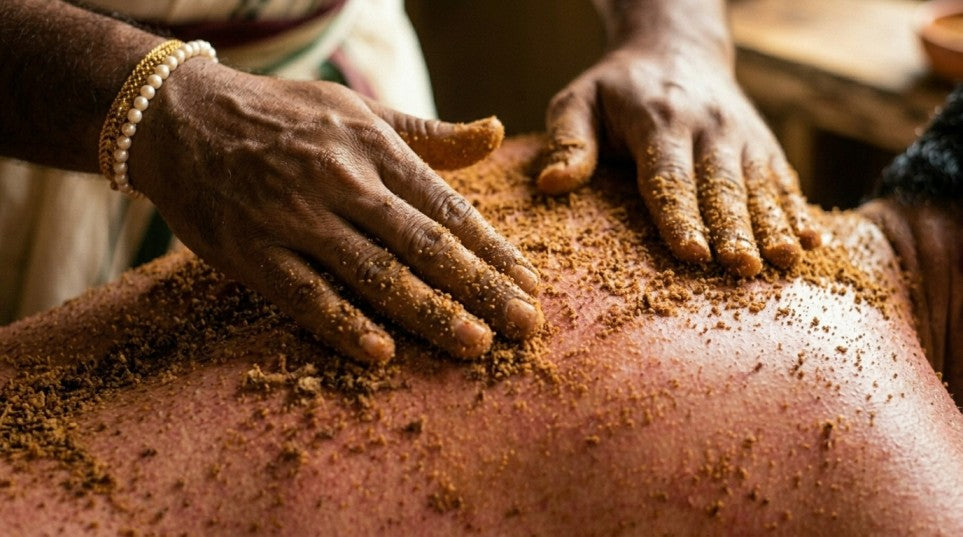
Every session begins with Abhyanga, a warm medicated oil massage focused on the neck, shoulders, upper back, and arms. The oils used most commonly for cervical spondylosis are Mahanarayan Taila (for degeneration and muscle tension), Ksheerabala Taila (for nerve involvement and tingling), and Dhanwantharam Taila (for dry, Vata-type stiffness).
The massage is followed immediately by Swedana (localised steam or hot towel therapy) to the neck and shoulder region. Together these open the channels, relax the chronically tense cervical muscles, improve local circulation, and prepare the tissue for the targeted procedures that follow. Without this preparation, Greeva Basti is significantly less effective.
2. Greeva Basti
Greeva Basti is to the neck what Kati Basti is to the lower back. A dough ring is placed on the back of the neck and filled with warm medicated oil. The oil sits in contact with the cervical spine for 30 to 45 minutes at a precisely maintained temperature.
The warmth dilates the blood vessels in the area, improving circulation to the cervical disc and joint tissue. The oil penetrates through the skin and muscle layers to reach the cervical vertebrae, disc structures, and joint capsules directly. The herbal actives in the oil nourish the desiccated disc tissue, reduce the inflammatory swelling in the facet joints, and calm the irritated nerve roots that are producing the tingling and arm pain.
Most patients notice improved neck mobility and reduced morning stiffness within 3 to 5 Greeva Basti sessions.
3. Nasya
This is the procedure that most cervical spondylosis treatment programmes leave out, and it is specifically the one that addresses the neurological symptoms most directly.
Nasya is medicated oil administered through the nostrils. The nasal passage provides direct access to the brain and the cervical nerve channels through the olfactory nerve pathway. Medicated oils (particularly Ksheerabala Taila) reach the cervical nerve roots, the C5, C6, C7, C8 roots that are most commonly compressed in cervical spondylosis, through this cranial route. No other procedure in Ayurveda can deliver therapeutic oil to the cervical nerve roots as directly as Nasya.
Classical Ayurvedic texts list both Manyastambha and Vishvachi as primary indications for Nasya, which is why, at Yuvrit, every cervical spondylosis programme with significant neurological symptoms includes a Nasya sequence.
4. Elakizhi: For Acute Pain and Muscle Spasm
When there is significant acute muscle spasm, heat, or severe localised pain, Elakizhi provides targeted herbal anti-inflammatory therapy. Bundles of medicinal leaves, including Nirgundi (Vitex negundo, specifically anti-inflammatory for nerve and musculoskeletal conditions), Eranda (castor), and Arka, are warmed and used to massage and heat the neck, shoulder, and arm simultaneously. This can reduce acute pain and spasm within a single session.
5. Vasti: Addressing the Root
For cervical spondylosis with significant nerve compression, a Vasti (medicated enema) sequence is included to address the systemic Vata through the colon. The colon is the primary seat of Vata in Ayurveda, and pacifying Vata here, through Anuvasana Basti (oil enema) with Ksheerabala Taila, produces nerve-nourishing effects throughout the body, including at the cervical level.
Conditions Connected to Cervical Spondylosis
Cervical spondylosis rarely exists in isolation. These conditions frequently co-exist:
-
Migraine: Upper cervical nerve irritation (C2-C3) directly triggers the trigeminal pathway involved in migraine. Many patients whose migraines are accompanied by neck stiffness find that both the headache frequency and the neck symptoms improve together when the cervical condition is treated.
-
Lower back pain: Desk workers often carry both cervical and lumbar degeneration simultaneously, driven by the same Vata-drying process at different spinal levels.
-
Sciatica: When both cervical and lumbar nerve compression are present, the Basti and internal herbal protocol at Yuvrit addresses the systemic Vata condition that is driving both.
Daily Habits That Make the Treatment Last
Treatment can relieve pain and restore mobility, but what determines whether those results last is what you do every day after. Cervical issues are largely driven by small, repeated habits: posture, screen use, sleep position, and muscle tension patterns. Correcting these daily lifestyle habits reduces strain on the neck, supports tissue healing, and prevents the condition from returning. These simple practices help maintain the benefits of treatment and protect the spine long-term.
-
Sit with the screen at eye level, eliminating the forward head tilt that is the primary postural driver of cervical degeneration.
-
Set a timer to stand and stretch the neck every 45 minutes of desk work.
-
Sleep with one pillow that maintains the natural cervical curve, not thick foam pillows that push the head forward.
-
Daily warm sesame oil self-massage of the neck and shoulders before bathing, for 10 minutes.
-
Pranayama (Nadi Shodhana or alternate nostril breathing) for 10 minutes daily directly nourishes the cervical nerve channels through the nasal pathway, the same route as clinical Nasya.
Start Treating the Cause, Not Just the Pain
Panchakarma cannot reverse bone spurs or fully restore disc height that has already been lost. What it achieves is: preventing further degeneration, significantly reducing pain and stiffness, improving the remaining disc tissue quality, and, most clinically important, addressing the neurological symptoms (tingling, numbness, weakness) that are the most disabling aspects of the condition. Most patients achieve sustained functional improvement and lasting pain reduction through a proper programme.
Cervical Spondylosis Panchakarma Treatment: Questions Patients Commonly Ask
Q: Why do neck pain and tingling in the arm keep returning even after physiotherapy or painkillers?
A: Cervical spondylosis is a degenerative condition involving gradual disc dehydration, joint wear, muscular tightness, and sometimes nerve compression. Painkillers may temporarily reduce discomfort, while physiotherapy helps strengthen surrounding muscles, but neither may fully address the underlying tissue degeneration, dryness, inflammation, or poor circulation contributing to the condition. Ayurveda approaches cervical spondylosis by focusing on improving tissue nourishment, reducing Vata imbalance, improving circulation to the cervical spine, and calming irritated nerve pathways rather than only suppressing pain symptoms.
Q: How does Panchakarma help in cervical spondylosis and cervical radiculopathy
A: Panchakarma for cervical spondylosis is designed to reduce Vata-Kapha imbalance, improve spinal lubrication, reduce muscular rigidity, and support cervical nerve health. Therapies such as Abhyanga, Swedana, Greeva Basti, Nasya, and Vasti work together in a structured sequence to improve circulation, nourish degenerating tissues, reduce stiffness, and calm irritated nerve roots. In individuals with tingling, numbness, or radiating arm pain, these therapies may help reduce neurological irritation and improve mobility gradually over time.
Q: Why are desk work and phone usage considered major causes of cervical spondylosis?
A: Prolonged forward head posture while using laptops, phones, or desktop screens places excessive mechanical strain on the cervical spine. As the head shifts forward from its natural alignment, the neck muscles remain under constant tension to support the extra load. Over time, this reduces circulation, increases muscular tightness, accelerates disc dehydration, and contributes to progressive cervical degeneration. Ayurveda recognizes this as chronic Vata aggravation caused by repetitive postural stress and tissue dryness.
Q: What is Greeva Basti and why is it important in neck pain treatment?
A: Greeva Basti is a specialized Ayurvedic therapy in which warm medicated oil is retained over the cervical spine using a dough ring structure. The sustained warmth improves blood circulation, softens stiffness, nourishes cervical tissues, and helps calm irritated nerve roots. It is considered one of the most targeted Ayurvedic therapies for cervical spondylosis because it directly addresses the neck region where degeneration, muscular spasm, and nerve compression occur. Many individuals notice improved neck mobility and reduced stiffness after a few sessions.
Q: Can Panchakarma permanently cure cervical spondylosis?
A: Panchakarma cannot completely reverse advanced structural degeneration such as severe bone spur formation or major disc height loss. However, it may significantly reduce pain, stiffness, nerve irritation, and progression of degeneration when performed consistently and combined with lifestyle correction. Many individuals experience improved mobility, reduced tingling and numbness, better posture tolerance, and fewer recurring flare-ups after treatment. Long-term outcomes depend heavily on posture correction, ergonomic habits, regular movement, stress management, and maintaining spinal health after therapy.
Related post
27
Apr
24
Apr
24
Apr
